Oil Seal Shelf Life: What ISO 6194-3 and ISO 2230 Say
ISO 6194-3 caps stored lip seal life at 7 years for NBR and 10 for FKM, and only when the seals are stored to ISO 2230. Here is how to check a box before it is fitted.
Oil Seal Shelf Life: What ISO 6194-3 and ISO 2230 Say
ISO 6194-3 caps stored lip seal life at 7 years for NBR and 10 for FKM, and only when the seals are stored to ISO 2230. Here is how to check a box before it is fitted.
Short answer
A rotary shaft lip seal has no use-by date printed on it, and neither standard gives one either. What they give is a storage life guideline that depends on the elastomer. ISO 6194-3, the part of the ISO 6194 family that covers storage, handling and installation, states a maximum of 7 years for seals with NBR, HNBR, or ACM and AEM sealing elements and 10 years for FKM, in its Table 1. It attaches a condition to those numbers: they apply to seals stored in accordance with ISO 2230 and with the storage clauses of ISO 6194-3 itself. ISO 2230 is the general storage guide for rubber products and it counts differently. It sorts elastomers into three groups and gives an initial storage period followed by an extension that is granted only after an inspection. For NBR that is 7 years plus 3, for FKM 10 years plus 5. A lip seal gets the shorter of the two figures, because a thin lip, a metal garter spring and a rubber-to-metal bond do not carry the same ageing margin as a solid rubber part. If the compound is not listed in either table, ISO 6194-3 says the storage time should be agreed between purchaser and supplier.
Two documents, two ways of counting
| ISO 6194-3 | ISO 2230 | |
|---|---|---|
| What it is | Part 3 of the lip seal family: storage, handling and installation | General guidelines for storage of rubber products |
| How the figure is stated | Table 1, storage life guideline in years, maximum, by elastomer | Initial storage period plus an extension granted after inspection |
| NBR | 7 years | 7 years plus 3 |
| FKM | 10 years | 10 years plus 5 |
| Condition attached | Applies to seals stored in accordance with ISO 2230 and this part of ISO 6194 | Applies to unassembled parts packaged and stored as the guide recommends |
| Material not listed | Storage time to be agreed between purchaser and supplier | Place the compound in a group and apply that group's period |
| Status | Edition 2, published in 2009, still the current version | Third edition published in March 2026; the 2002 edition was withdrawn at that point |
The figures themselves
Table 1 of ISO 6194-3 lists four elastomer types:
| Elastomer type (designation) | Storage life guideline, years, max. |
|---|---|
| Fluorocarbon (FKM) | 10 |
| Polyacrylate (ACM or AEM) | 7 |
| Butadiene/acrylonitrile (NBR) | 7 |
| Hydrogenated NBR (HNBR with some unsaturation) | 7 |
Two things in that table are easy to miss. The heading says "years, max.", so these are ceilings and not targets. And the table stops at four materials. VMQ, EPDM and any other compound used for a lip sealing element is not in it, and clause 4.5 covers that case directly: the storage time for seals made of materials other than those shown in Table 1 should be agreed between purchaser and supplier.
ISO 2230 works from groups instead of individual compounds:
| Group | Elastomers | Initial storage period | Extension after inspection |
|---|---|---|---|
| A | BR, NR, IR, SBR, AU, EU | 5 years | 2 years |
| B | NBR, XNBR, HNBR, CR, ACM, CO, ECO, IIR, BIIR, CIIR | 7 years | 3 years |
| C | CM, CSM, EPM, EPDM, FKM, VMQ and other silicone rubbers | 10 years | 5 years |
The extension in the last column is not automatic. It is granted after a representative sample is inspected at the end of the initial period, and the periods apply only to unassembled parts that were packaged and stored as the guide recommends. Parts stored under other conditions get a shorter period.
Why a lip seal gets the shorter number
Three features of the finished part age on a different clock than a test slab of the same compound:
| Feature | What is at stake | What storage does to it |
|---|---|---|
| Sealing lip edge | A fraction of a millimetre at the contact line | Heat and time raise hardness and cut elastic recovery, and the contact line is where that shows first |
| Garter spring and metal case | Spring wire and case are thin steel | Humidity and condensation corrode them, and the spring is the load that holds the lip on the shaft |
| Rubber-to-metal bond | A bonded interface, not bulk rubber | Absorbed fluid or solvent contact can break the bond between element and case |
A bulk rubber part can lose a few points of hardness and still do its job. A lip seal that has lost elastic recovery at the contact line, or whose spring has corroded, has lost the two things that make it seal at all.
What storage has to look like for the figure to mean anything
| Condition | What the guidance asks for | What goes wrong when it is ignored |
|---|---|---|
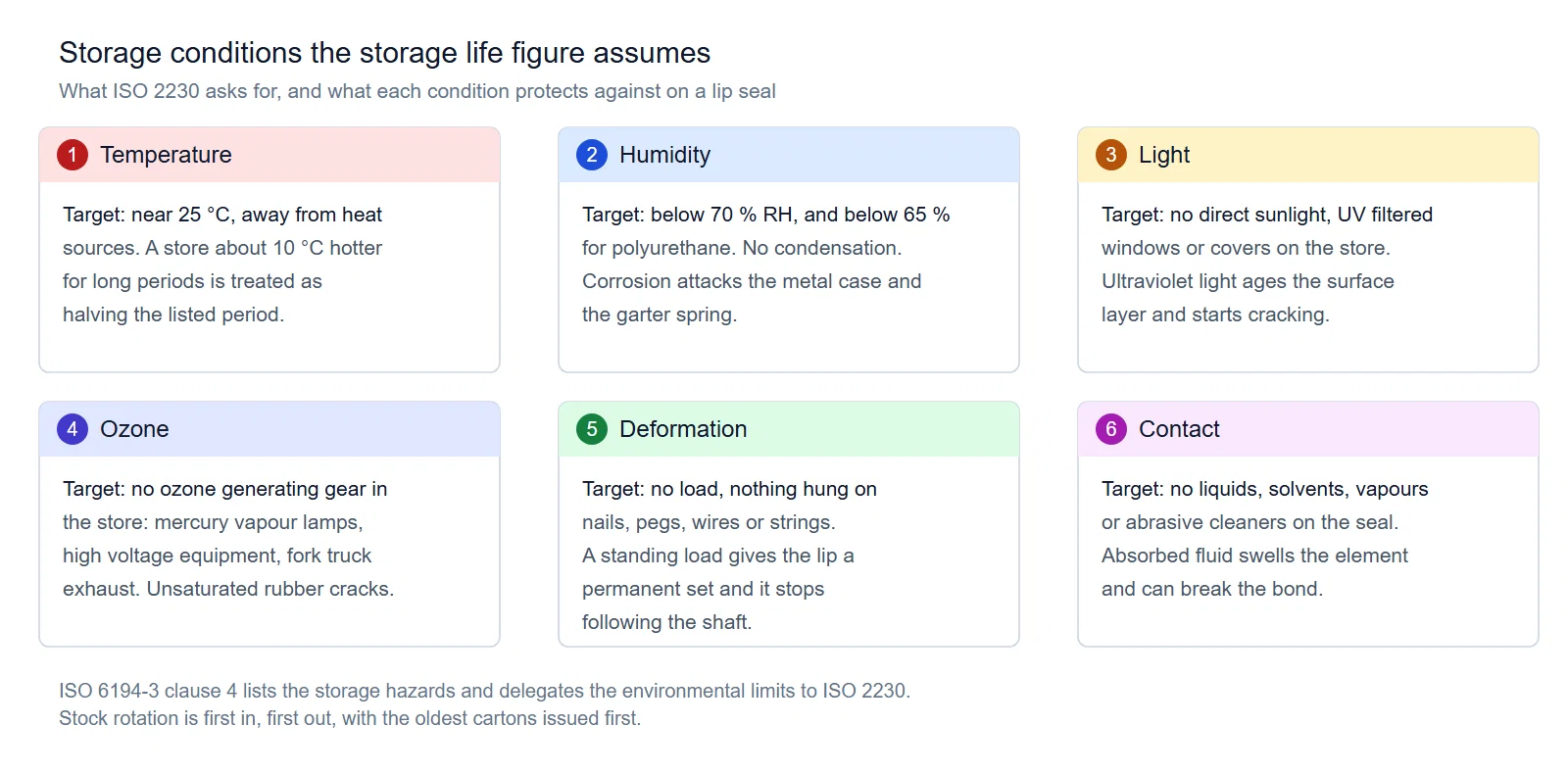
| Temperature | Store near 25 °C and away from heat sources. Guidance drawn from ISO 2230 treats a store running about 10 °C above that for long periods as halving the listed life | Continued crosslinking raises hardness and lowers resilience |
| Humidity | Relative humidity below 70 %, and below 65 % for polyurethane compounds, with no condensation | Corrosion on metal cases and springs, water pickup by some compounds |
| Light | No direct sunlight, no artificial light with a high ultraviolet content, windows covered with a UV filtering film | Surface cracking and early ageing of the surface layer |
| Ozone | No ozone generating equipment in the room, such as mercury vapour lamps, high voltage gear, or the exhaust of internal combustion fork trucks | Cracking of unsaturated rubber, starting at the lip edge |
| Deformation | Store free from tension and compression. No hanging on nails, pegs, wires or strings, no crushing under heavy stacks | Permanent set, a flattened lip that no longer follows the shaft |
| Contact | No contact with liquids, semi-liquids, vapours, solvents or corrosive cleaners unless they are part of the packaging | Swelling, softening, breakdown of the rubber-to-metal bond |
| Stock rotation | First in, first out, with the oldest cartons issued first | The oldest stock reaches the end of its period unrecorded |
The Japanese national adoption of this part, JIS B 2402-3, states that the storage area shall be kept at 30 °C or under and at 40 % to 70 % average humidity, and it requires first in, first out rotation. ISO 6194-3 itself delegates the environmental conditions to ISO 2230 instead of repeating numbers, which is worth knowing when a supplier quotes a storage life without quoting the condition that goes with it.
Four ways a stored seal stops being usable
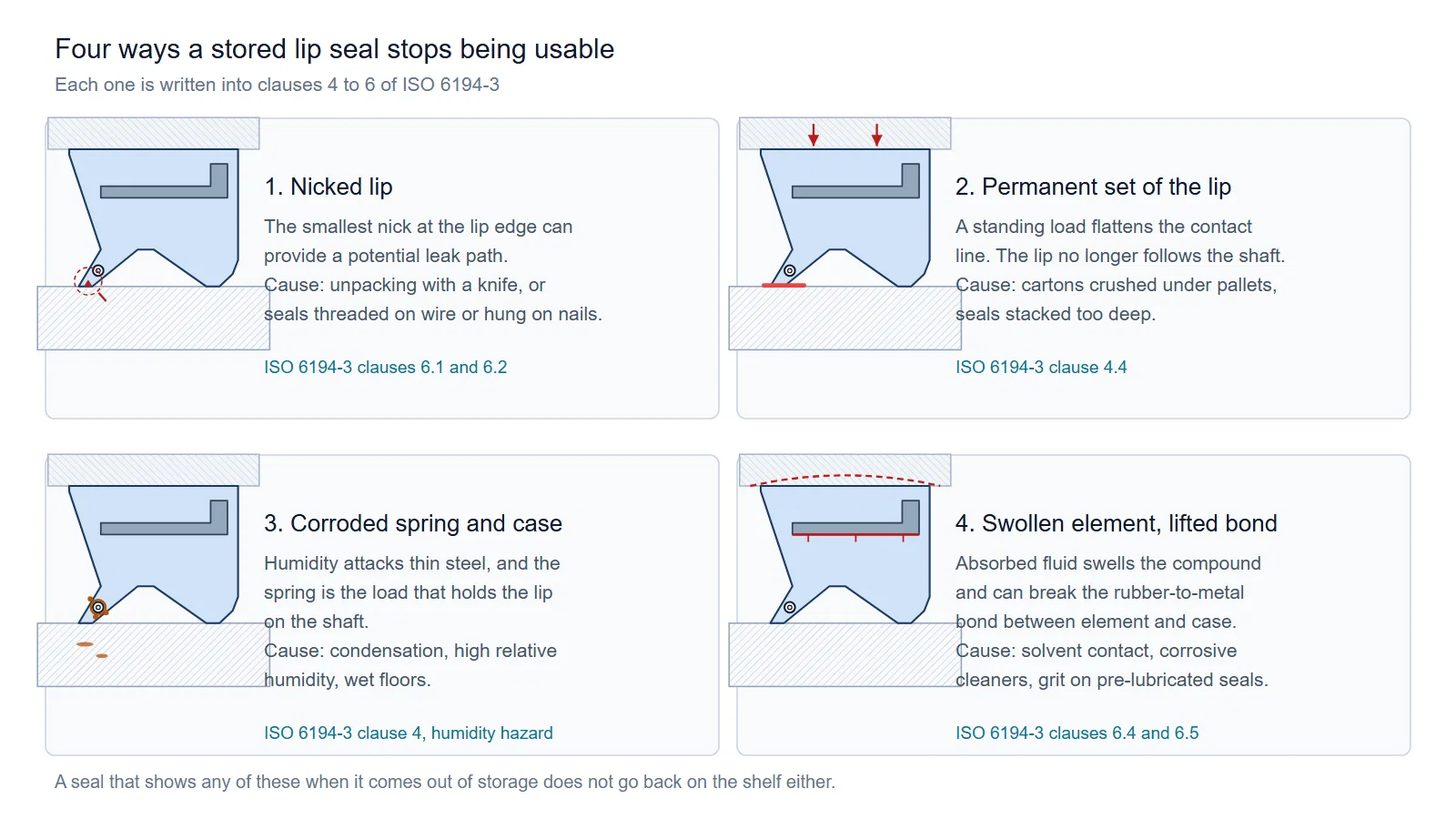
ISO 6194-3 is explicit about each of these in clauses 4 to 6:
- A nicked lip. Clause 6.1: seal lips are extremely vulnerable to damage and the smallest nick can provide a potential leak path. Clause 6.2: seals shall never be threaded on wires or strings or hung on nails or pegs, because mishandling that way can distort or cut the lip.
- A permanently deformed lip. Clause 4.4: when cartons of lip seals are stacked, care shall be taken to avoid damage to the cartons at the bottom from excessive weight. A carton crushed under a pallet puts a standing load on the lip.
- A corroded case or spring. Clause 4 draws attention to humidity as a storage hazard. Corrosion on the spring attacks the load that keeps the lip in contact with the shaft.
- A contaminated or swollen element. Clause 6.4: seal surfaces shall be free of grit, chips and other abrasives, and pre-lubricated seals are particularly susceptible to that hazard. Clause 6.5: if cleaning becomes necessary, the manufacturer shall be asked to recommend a suitable cleaning solution, abrasive cleaners shall never be used, and solvents, corrosive liquids and chemical cleaners shall not be allowed to contact the seals because they can be absorbed, break down the rubber-to-metal bond, or damage the case and spring.
What to check before a stored seal goes into a machine
| Check | Method | What the result tells you |
|---|---|---|
| Identity and age | On the label: compound designation, batch number, date of packaging, date of receipt | Without a packaging date there is no way to apply any storage life figure, because the clock starts there |
| Visual condition | ISO 2230 lists permanent deformation, mechanical damage, surface cracking seen under 10x magnification, and changes in surface condition. ISO 6194-5 covers identification of visual imperfections on lip seals | Cracking at the lip edge, a flattened contact line or surface tackiness mean the part is not going back on the shelf either |
| Hardness | ISO 48 or ISO 7619-1, compared with the value declared for the batch under ISO 6194-4 | A compound that has drifted hard will not follow the shaft the way it did when it was made |
| Compression set | ISO 815, the maximum value declared for the batch under ISO 6194-4 | How much elastic recovery the lip has left |
| Mass change in the test fluid | ISO 1817 | Whether the compound still responds to the fluid it was specified for |
| Bond and case | Visual under magnification, looking at the bonded edges | Lifting at the bond edge or rust on the case ends the part |
ISO 2230 also asks for the record itself: the quantity of each stored item, the initial packaging date, the date of receipt, the date of any repackaging, the manufacturer's batch number, and the quantity taken as representative samples. Those fields are what let anyone apply a storage life figure at all.
On installation day, clause 7.1 asks for the seal to be examined before fitting to confirm it is clean and undamaged, and clause 7.2 calls for a light application of a suitable clean lubricant on the sealing lips, with the amount and type agreed between purchaser and supplier. Clause 5.3 is the one that ties the section together: seals shall never be removed from their packaging until they are ready for installation.
Questions buyers ask us
How long can I keep a box of NBR lip seals?
Seven years is the figure in Table 1 of ISO 6194-3, and it is a maximum for seals stored to ISO 2230. If the carton has been sitting in a hot warehouse, on a work bench, or under a pallet, the number that applies is shorter, and the standard does not say by how much.
Does the clock start at manufacture or at delivery?
At the packaging date. That is why ISO 2230 asks for the initial packaging date and the date of receipt to be recorded as separate fields, and why a supplier who prints only a delivery date is not giving you enough to work with.
Can I extend the life by inspecting the seals?
Under ISO 2230, yes for rubber products in general: inspect a representative sample at the end of the initial period and the period can be extended by 2, 3 or 5 years depending on the group. For a lip seal, Table 1 of ISO 6194-3 is written as a maximum, so the extension route does not raise the ceiling. It only tells you whether stock already inside the period is still sound.
What about seals with a thermoplastic (PTFE) sealing element?
ISO 6194 covers seals with elastomeric sealing elements and is described as complementary to ISO 16589, which covers seals with thermoplastic elements. The storage life figures in Table 1 of ISO 6194-3 do not carry over to a thermoplastic lip. Ask for the storage life to be stated in the supply specification, together with the storage conditions it assumes.
Is a whitish film on the rubber a defect?
Usually not. A whitish film is generally bloom, an ingredient migrating to the surface of the compound. The inspection list in ISO 2230 looks for permanent deformation, mechanical damage, surface cracking under 10x magnification, and changes in surface condition, and a surface that has gone hard, soft or tacky is the one that matters. Dust and grit are a separate issue under clause 6.4, and pre-lubricated seals pick them up most easily.
What should I ask a supplier to print on the carton?
Compound designation, batch number, date of manufacture or packaging, quantity, and which storage guideline the quoted life comes from. Those are the fields ISO 2230 asks to be recorded, and they are the fields that let a warehouse apply first in, first out to something with no visible date code.
Putting it on your own paperwork
The useful move is to treat storage life as a stated specification rather than a question to ask after delivery. Name the compound, name the standard the life figure comes from, name the storage conditions the figure assumes, and ask for the packaging date and batch number on the carton. Then rotate stock first in, first out and inspect a sample at the end of the period instead of assuming the last carton on the shelf is the same as the first one was.
- Standards referenced in this article: ISO 6194-1, ISO 6194-3, ISO 6194-4, ISO 6194-5, ISO 2230, ISO 48, ISO 7619-1, ISO 815, ISO 1817, ISO 2781, ISO 16589, JIS B 2402-3.
Need help specifying a seal?
Use these checks to prepare your enquiry. Final suitability depends on the specific design and operating conditions.
Check dimensions and design
Provide the shaft diameter, housing bore and seal width in mm. Include the part marking, lip profile or a dimensioned drawing if available.
Describe operating conditions
Share the fluid or medium, operating temperature, pressure and shaft speed. Confirm the material grade against the application.
Verify a replacement
Provide the original part number and photos. Similar dimensions alone do not confirm interchangeability; compare the design and material.