Oil Seal Material Compatibility: Testing Swell Before You Commit
ISO 1817 immersion testing measures the swell and hardness change behind oil seal material compatibility, and ISO 6194-4 clause 4.2 makes the mass change a declared value.
Oil Seal Material Compatibility: Testing Swell Before You Commit
ISO 1817 measures how a rubber test piece changes in mass, volume, dimensions, hardness and tensile properties after immersion in a test liquid. ISO 6194-4 clause 4.2 sets the maximum mass change as a declared value for every batch.
Short answer
Oil seal material compatibility is established by immersion testing, not by a compatibility chart. ISO 1817 is the method: a vulcanized rubber test piece of 2 mm ± 0.2 mm thickness is immersed in a specified liquid at a specified temperature for a specified time, and the changes in mass, volume, dimensions, hardness and tensile stress-strain properties are measured against the unexposed piece. Results are reported as the median of three test pieces. For rotary shaft lip seals, ISO 6194-4 clause 4.2 requires the compound supplier to declare a maximum mass change in a test liquid, measured by ISO 1817, alongside the nominal density, the nominal hardness and the maximum compression set. Two decisions have to be read separately. The first is whether the liquid will attack the polymer. The second is what the intended swell is, because a lip seal needs a small, controlled swell to seat, and a harmless looking volume change can still throw the lip contact force out of range. Reference oils IRM 901, IRM 902 and IRM 903 are graded by aniline point, and a single test in the middle grade does not describe the other two.
Two questions the word compatibility hides
The word gets used for two different questions, and a data table answers only one of them.
The first question is about chemical attack. The liquid dissolves into the polymer, the crosslink network changes, and the compound either hardens, cracks, or loses its tensile strength. ISO 1817 catches this through the change in tensile stress-strain properties and through the appearance of the test piece, which is reported next to the numbers.
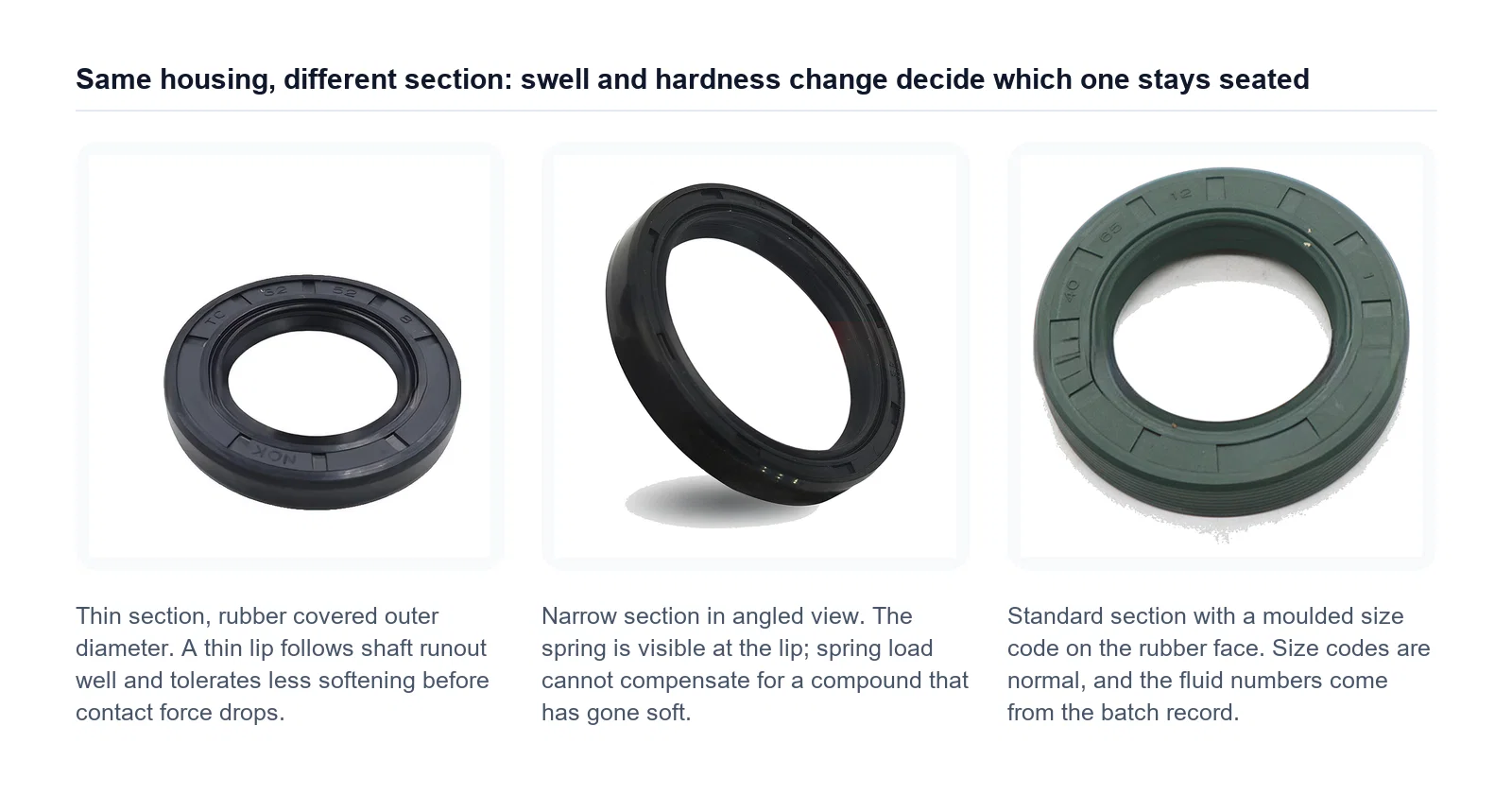
The second question is about dimension. The same absorption that attacks the polymer also increases the volume of the part. In a lip seal this is not automatically bad. The lip has to press against the shaft, and a small amount of swell increases the contact force. Too much swell and the lip goes soft and the spring cannot hold the contact line where it was set. Hardness change tells you which of those two directions you are heading in.
A compound can pass one question and fail the other. A seal compound that swells 8 percent in a test oil and keeps its hardness is often usable. A compound that swells the same 8 percent and drops ten points of hardness is not, because the lip will no longer follow the shaft. The immersion report carries both numbers, and selection has to be made on both.
The values ISO 6194-4 wants on the batch record
ISO 6194-4 clause 4.2 does not hand out pass limits. It requires values to be declared, per batch. The list is short.
| Value | Test method | What it fixes in a lip seal |
|---|---|---|
| Compound grade and batch code | Identification | Ties the physical numbers to a specific mixing operation |
| Nominal density | ISO 2781 | Detects filler substitution between batches |
| Nominal hardness | ISO 48, or ISO 7619-1 | Sets the base contact force of the lip |
| Maximum compression set | ISO 815 | Predicts how much contact force is lost when the seal sits under compression |
| Maximum mass change in a test liquid | ISO 1817 | Establishes fluid resistance and the intended swell window |
For low temperature service the same clause points to ISO 1432 or ISO 2921 for the low temperature property. Both are separate tests and neither replaces the immersion result.
The practical reading is that ISO 6194-4 gives you a statement and a method, but the number itself is negotiated. Two suppliers can both work to ISO 6194-4 and declare different maximum mass changes for different oils, and both records are correct. The purchase order has to name the oil and the condition, or the declared value cannot be checked against anything.
How the immersion test is actually run
ISO 1817 defines five methods, lettered A to E, because the liquids differ in volatility. The choice of method is part of the result.
| Method | Apparatus | Applies to | Liquid to specimen volume |
|---|---|---|---|
| A | Glass container with ground glass stopper | Non volatile liquids and volatile liquids below boiling point | about 80 to 1 |
| B | Stoppered glass container, evaporation minimised | Non volatile liquids and volatile liquids below boiling point | at least 15 to 1 |
| C | Glass container with reflux condenser | Volatile liquids near boiling point | at least 15 to 1 |
| D | Sealed pressure vessel | Liquids above boiling point and flammable liquids | at least 15 to 1 |
| E | Single sided contact fixture | One face of the test piece only, as in a diaphragm | Not applicable |
A test piece made to ISO 23529 is nominally 2 mm thick, and the standard expects the thickness to be brought to that value rather than accepted as moulded. Articles thinner than about 1.8 mm are tested at their own thickness. Immersion intervals step in a fixed ladder, and 24 h, 72 h, 7 days and multiples of 7 days are the usual points. The short early intervals matter because absorption starts as a function of the square root of time, and the shape of that curve tells you whether the compound has reached saturation or is still taking up fluid.
Measurement is time critical. For volatile liquids the standard requires the mass, volume and dimensional readings to be completed inside 2 minutes after the test piece leaves the liquid, otherwise the fluid evaporates off the surface and the change is reported low.
Two more rules are worth putting into the test request. The test liquid is generally not to be replaced during the immersion, and where replacement is prescribed the standard gives intervals in a table, which for engine type oils runs to 504 h and for hypoid gearbox type oils to 336 h at 125 to 140 °C, tightening to 168 h at 141 to 150 °C. When mineral oil is the test liquid, the report has to carry the density, the refractive index, the viscosity and the aniline point or aromatic content of that oil. An immersion report that names the oil only as mineral oil is not a report you can compare with anything.
Reference oils are graded, and the grade changes the answer
The three reference oils used for rubber swelling tests are defined by aniline point. The lower the aniline point, the more aromatic the oil and the more aggressive it is toward most elastomers.
| Reference oil | Aniline point | Aromatic content | Swelling against rubber | Reads as |
|---|---|---|---|---|
| IRM 901 | about 124 °C | Low | Mild | Paraffinic mineral oils, hydraulic fluids, transformer oils |
| IRM 902 | about 93 °C | Medium | Moderate | Average mineral oils, engine oils, gear lubricants |
| IRM 903 | about 70 °C | High | Severe | Aromatic rich oils and high solvency fluids |
These three replaced the older ASTM No. 1, No. 2 and No. 3 oils and are specified through ASTM D5964. The severity order IRM 903, then IRM 902, then IRM 901 follows the aniline point directly.
The consequence for a purchase specification is blunt. A compound tested in IRM 902 has not been tested in IRM 903, and there is no conversion factor between them. A document that states oil resistant without naming the oil and the condition cannot be audited. Written as oil resistance tested by ISO 1817, 70 hours at 100 °C in IRM 903, the same claim becomes checkable.
For a complete fluid assessment, ISO 6072 goes further in the other direction. It specifies the formulations, the mixing procedures and the vulcanization procedures for standard elastomer compounds, two nitrile grades plus one each of fluorocarbon, EPDM and hydrogenated nitrile, so that hydraulic fluids can be graded against a fixed baseline rather than against whichever commercial compound a lab happens to have. The standard is explicit that it does not provide formulations for seals in actual service. Its purpose is to compare fluids, not to approve a seal compound. ISO 13226 serves the same function for the elastomer sheet itself, covering acrylic, nitrile in several acrylonitrile levels, chlorobutyl, chloroprene, EPDM, fluorocarbon, hydrogenated nitrile, natural rubber and silicone in its annexes.
Fluid families that invert the material choice
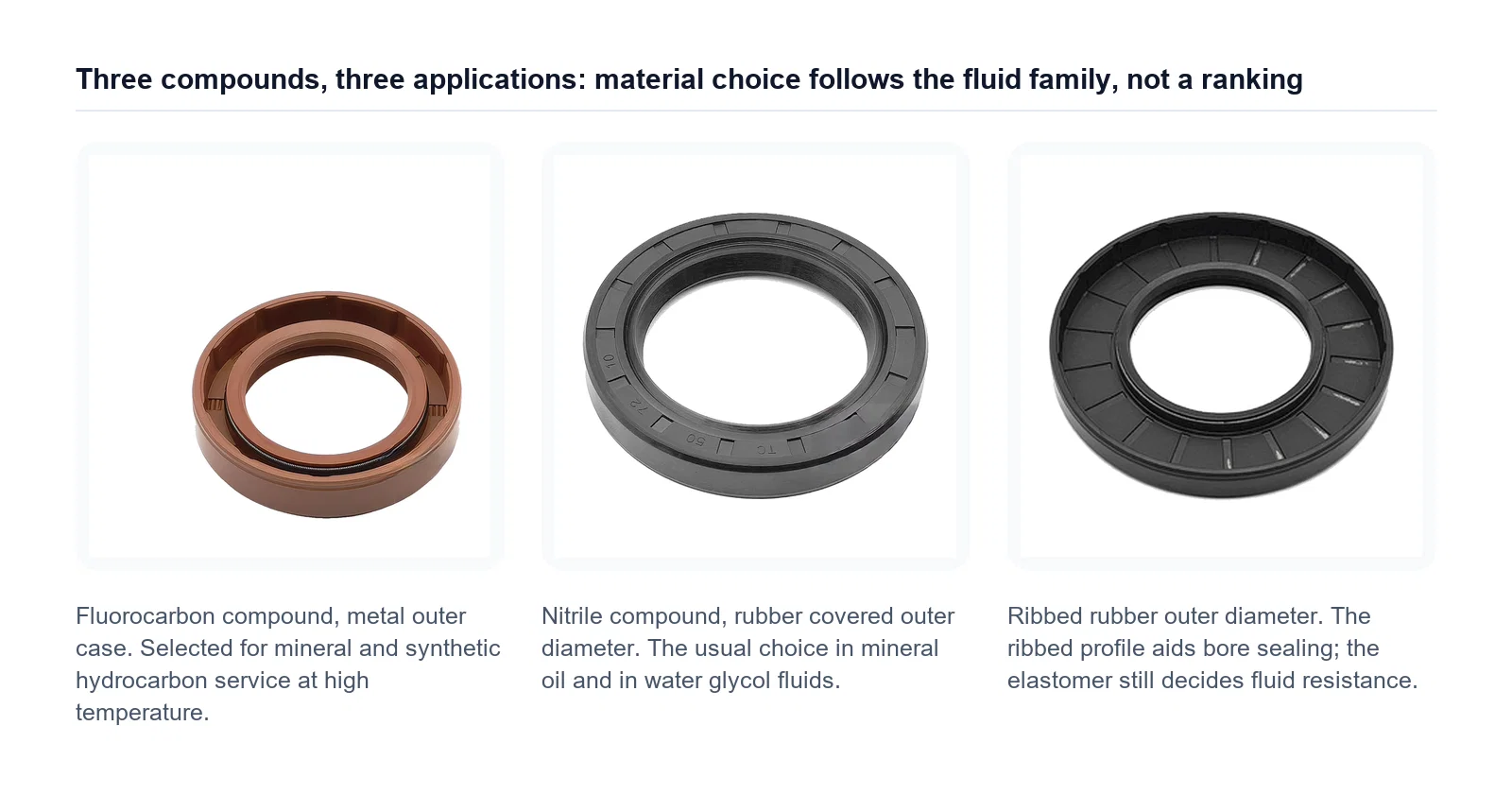
Elastomer families are not ranked on a single scale. The families swap places depending on the base fluid, and three reversals catch buyers out.
| Fluid family | Points to | Caution |
|---|---|---|
| Mineral oils and greases | Nitrile and fluorocarbon families | Not a single fluid; additives and aromatic content decide the swell |
| Water glycol, HFC | Nitrile grades are the common choice in this class | The water fraction drives the failure, not the glycol, and the fluid runs against a temperature ceiling |
| Phosphate ester, HFD-R | EPDM family | Nitrile and fluorocarbon are both listed as unsuitable, so a fluid change from mineral oil forces a seal change as well |
| Synthetic ester, HEES | Fluorocarbon and hydrogenated nitrile | Biodegradable fluids still attack the wrong compound; the ester base is polar |
Note what the EPDM row means in practice. EPDM is also the family that is unsuitable in mineral oil, so a system that switches between a phosphate ester fill and a mineral oil fill has no single elastomer that covers both. The seal change and the fluid change have to be planned as one event, not a top up.
Fluorocarbon compounds sit at the other end and behave well in mineral oil and most synthetic hydrocarbons, but they are attacked by phosphate esters and by high pH aqueous fluids. That is the same fluid class in which EPDM is the only broadly recommended family. The two facts are consistent, and they are the reason a compatibility table without a named fluid is not usable.
Immersion numbers are read against the wrong target
The most persistent error in seal material selection is treating the lowest volume change as the best result. Immersion test data does not support that reading, and the standard says so in a footnote to its precision annex: the test simulates service conditions to some extent but is not directly related to actual performance, and the elastomer with the smallest volume change may not be the most suitable in service.
Two mechanisms explain the gap.
The first is thickness. A 2 mm test piece absorbs a greater proportion of its mass than a 5 mm lip section does in the same fluid and the same time, so a compound can look worse in the test than the finished part behaves. The second is permeation. Fluid that passes through the lip and evaporates on the air side removes itself from the calculation. A compound can be fully compatible with a fluid in the immersion test and still lose oil through the lip in service, which reads as a leak rather than as a material failure.
For a lip seal the useful question is the direction and size of the swell, plus whether the hardness holds. A compound that softens loses contact force. A compound that hardens loses the ability to follow shaft runout. Either one ends in a leak path, and neither is answered by picking the smallest volume change number in a table.
Reading the precision of the number you were given
ISO 1817 carries an interlaboratory precision annex, based on a trial run in 2011 on four compounds, natural rubber, nitrile, hydrogenated nitrile and fluorocarbon, tested against standard liquids and a reference oil. The published repeatability and reproducibility figures set a floor on how precise an immersion result can be.
| Property | Repeatability r | Reproducibility R |
|---|---|---|
| Change in mass, 24 h | about 2.6 percent | about 4.0 percent |
| Change in volume, 24 h | about 3.6 percent | about 4.6 percent |
| Change in hardness, 24 h | about 1.1 IRHD | about 4.2 IRHD |
| Change in tensile strength | about 4.8 percent | about 10.8 percent |
The practical consequence is that differences between two candidate compounds can disappear inside the method. A reported difference of 2 percent in volume change between two compounds is not a distinction; a difference of 15 percent is. When a specification is written with a margin of one or two percentage points, a laboratory comparison cannot enforce it.
The tensile figures are the worst case. Reproducibility for the change in tensile strength is about 10.8 percent, and for the change in elongation it goes higher still. Testing tensile properties after immersion is useful for spotting a compound that has genuinely degraded, but it is a poor instrument for ranking two compounds that are close together.
What the fluid does to each property
| Property being measured | What a rise means | What a fall means |
|---|---|---|
| Mass | Fluid absorbed, and extractable material leaving the compound | Material extracted faster than fluid absorbed, or surface loss |
| Volume | Swelling, which increases lip contact force up to a point | Shrinkage, which reduces contact force and can open the lip to the air side |
| Dimensions | Same as volume, but reported per axis so a moulded sealing edge can be tracked | Rare, and usually a sign of extraction rather than of a sealing material |
| Hardness | Stiffening from crosslink change, with a loss of the ability to follow the shaft | Softening, with a loss of contact force against the shaft |
| Tensile stress-strain | A shorter, harder compound, common after severe oxidation | The clearest sign of polymer breakdown in the fluid |
The surface condition is recorded next to these numbers and should be requested with them. Cracking, blistering, a change of colour or a tacky surface can show that a fluid attacks an elastomer even when the mass and volume changes are modest.
How to put this into a purchase specification
A material requirement that can be checked has four parts: the compound family, the fluid by name and type, the test condition, and the limit.
The shape of the sentence matters more than its length. Material to be tested by ISO 1817 in the specified fluid at the specified temperature and duration, with a maximum change in mass and a maximum change in volume stated as declared values, and with the test report to include the density, refractive index, viscosity and aniline point of any mineral oil used. That sentence can be checked against a delivered report. Oil resistant cannot.
Two conditions belong in the same clause rather than in a separate document. The first is the low temperature property by ISO 1432 or ISO 2921 if the seal is specified for cold service, because the immersion test says nothing about it. The second is the hardness tolerance, since the lip contact force depends on the delivered compound hardness and not on the nominal figure, and a compound that sits at the top of a hardness band behaves differently from one at the bottom.
Which oil should a seal be tested in if the application runs on a proprietary lubricant?
Test in the fluid the machine actually runs, and test a reference oil alongside it. The service fluid gives the number that matters; the reference oil gives a number that can be compared across suppliers and across years. Running only the reference oil leaves the actual fluid unmeasured. Running only the service fluid leaves nothing to compare against when the lubricant formulation changes.
Is the test temperature the average operating temperature?
No. The temperature should represent the highest sustained temperature the elastomer sees in service, not the average of the duty cycle. A seal that runs mostly at 60 °C with a sustained 110 °C at the sealing edge is tested at the higher figure, because the aging that matters happens there and absorption is faster.
Does a small volume change mean a good seal material?
It means the compound takes up little fluid. It does not mean the lip will hold. A lip seal needs a small, controlled swell to seat on the shaft, and a compound that swells almost nothing can sit on a film of oil without ever establishing contact. Volume change is one input to the decision, alongside hardness change, compression set and the low temperature property.
Is a material test report enough to approve a batch?
It is enough to show that the declared values were achieved on the test pieces submitted. It does not cover the moulded geometry of the part, the spring load, the sealing edge profile or the bonding between the rubber and the metal case. Those are covered by the dimensional requirements of ISO 6194-1 and, for surface imperfections, by the identification scheme of ISO 6194-5. For incoming inspection, ISO 2859-1 defines the switch between normal, tightened and reduced sampling; it sets a statistical risk level, not a promise about any individual batch.
How is an immersion result affected by who ran the test?
Materially. The reproducibility figures in the ISO 1817 precision annex are roughly twice the repeatability figures for the same property, and that gap is the difference between one laboratory repeating itself and two laboratories testing the same compound. Any limit that has to be enforced between a supplier and a buyer should be set with that gap in mind, especially for the tensile properties.
Test methods and standards referenced
- ISO 1817, determination of the effect of liquids on vulcanized or thermoplastic rubber
- ISO 6072, compatibility between hydraulic fluids and standard elastomeric materials
- ISO 13226, standard reference elastomers for characterizing the effect of liquids on vulcanized rubbers
- ISO 6194-4, performance test procedures for rotary shaft lip type seals
- ISO 6194-1, nominal dimensions and tolerances of rotary shaft lip type seals
- ISO 6194-5, identification of visual imperfections
- ISO 37, tensile stress-strain properties of rubber
- ISO 48, hardness of rubber, IRHD method
- ISO 7619-1, indentation hardness, durometer method
- ISO 815, compression set at ambient, high or low temperatures
- ISO 1432, low temperature stiffening, Gehman test
- ISO 2921, low temperature characteristics, temperature retraction procedure
- ISO 175, test methods for plastics, used for the chemical reagent list
- ISO 2781, determination of density of rubber
- ISO 23529, general procedures for preparing and conditioning test pieces
- ISO 2859-1, sampling procedures for inspection by attributes
- ISO 2230, storage of rubber products
- ASTM D5964, practice for rubber IRM replacement oils and reference materials
Need help specifying a seal?
Use these checks to prepare your enquiry. Final suitability depends on the specific design and operating conditions.
Check dimensions and design
Provide the shaft diameter, housing bore and seal width in mm. Include the part marking, lip profile or a dimensioned drawing if available.
Describe operating conditions
Share the fluid or medium, operating temperature, pressure and shaft speed. Confirm the material grade against the application.
Verify a replacement
Provide the original part number and photos. Similar dimensions alone do not confirm interchangeability; compare the design and material.