Oil Seal Designation: What the DIN 3760 Letters Leave Out
An oil seal designation names the case and the lips, not the material or the fit. What DIN 3760 forms and trade codes like TC actually commit a supplier to.
Oil Seal Designation: What the DIN 3760 Letters Leave Out
An oil seal designation names the case and the lips, not the material or the fit. What DIN 3760 forms and trade codes like TC actually commit a supplier to.
Short answer
An oil seal designation is the letter code that identifies a seal's construction. It names the outer case and the lip arrangement, and it tells you whether a garter spring loads the main lip. Under DIN 3760 the six common forms are A, AS, B, BS, C and CS. An S suffix adds a dust lip on the air side. Letter A stands for an elastomer-covered case, B for an exposed metal case, C for a reinforced one. Trade codes such as SC and TC describe the same constructions with a different key: there the first letter counts the lips and the second names the outer periphery. Neither scheme says anything about the elastomer, the temperature range or the pressure the seal tolerates. ISO 6194-1 clause 5.2 leaves the lip layout to agreement between manufacturer and purchaser, and the material goes to the data sheet that ships with the batch.
What the six forms actually describe
DIN 3760 sorts radial shaft seals by two construction decisions. One is the outer casing, which decides how the seal seats in the housing bore. Next comes the lip arrangement at the shaft. Six standard forms combine them.
| Form | Outer case | Lips | Common trade code |
|---|---|---|---|
| A | elastomer-covered | main lip with garter spring | SC |
| AS | elastomer-covered | main lip plus dust lip, spring | TC |
| B | exposed metal | main lip with garter spring | SB |
| BS | exposed metal | main lip plus dust lip, spring | TB |
| C | reinforced metal | main lip with garter spring | SA |
| CS | reinforced metal | main lip plus dust lip, spring | TA |
The case choice is a housing decision before it is a seal decision. Rubber on the outside diameter seals statically through the elastomer and tolerates a rougher bore surface. It also absorbs the thermal expansion gap between an aluminium housing and the seal, and replacing a rubber-covered part leaves the bore undamaged. A metal case presses into the bore with precise interference and holds against axial ejection better, but it needs a clean, dimensionally accurate bore. Any bore irregularity passes straight through it. Reinforced form C adds stiffness and an assembly-friendly cap, hence its place in larger sizes and harsher duty.
The S suffix is a contamination decision. Forms with an S suffix, meaning AS, BS or CS, carry a second lip on the air side that excludes dust and splash. That second lip runs dry and seals nothing: it excludes, it does not hold pressure. Any seal specified as TC when the drawing meant a plain single-lip part arrives with an extra lip and adds friction the application never asked for.
The same seal under different letters
Trade letter codes use their own two-position key. In the key one major seal maker's catalogue prints, the first letter names the lip configuration: S for a single sealing lip, T for a sealing lip plus dust lip. Letters V and K cover grease and dust duty with no garter spring. The second letter names the outer periphery: C for rubber covered, B for metal.
Set that key beside the table above and a trap appears. DIN form A maps to SC, because a rubber-covered single-lip part is exactly what SC means. Form C, a reinforced metal case, maps to SA and TA. Those second letters do not spell out the DIN letters. Translate between the schemes. Never parse character by character. Buyers who read SB as "seal, B-form" will order the wrong case.
Codes drift between catalogues too. Distributors stack their own two-letter prefixes on top, which adds a third naming layer. One catalogue lists all six forms under DIN 3760; another assigns the metal-cased ones to DIN 3761. Two catalogues can put different letters on a physically identical seal, and a letter match alone does not ensure a match in fit, in form or in function. Measured dimensions carry more weight in an enquiry than any letter string, and a supplier should be asked to state the construction in words.
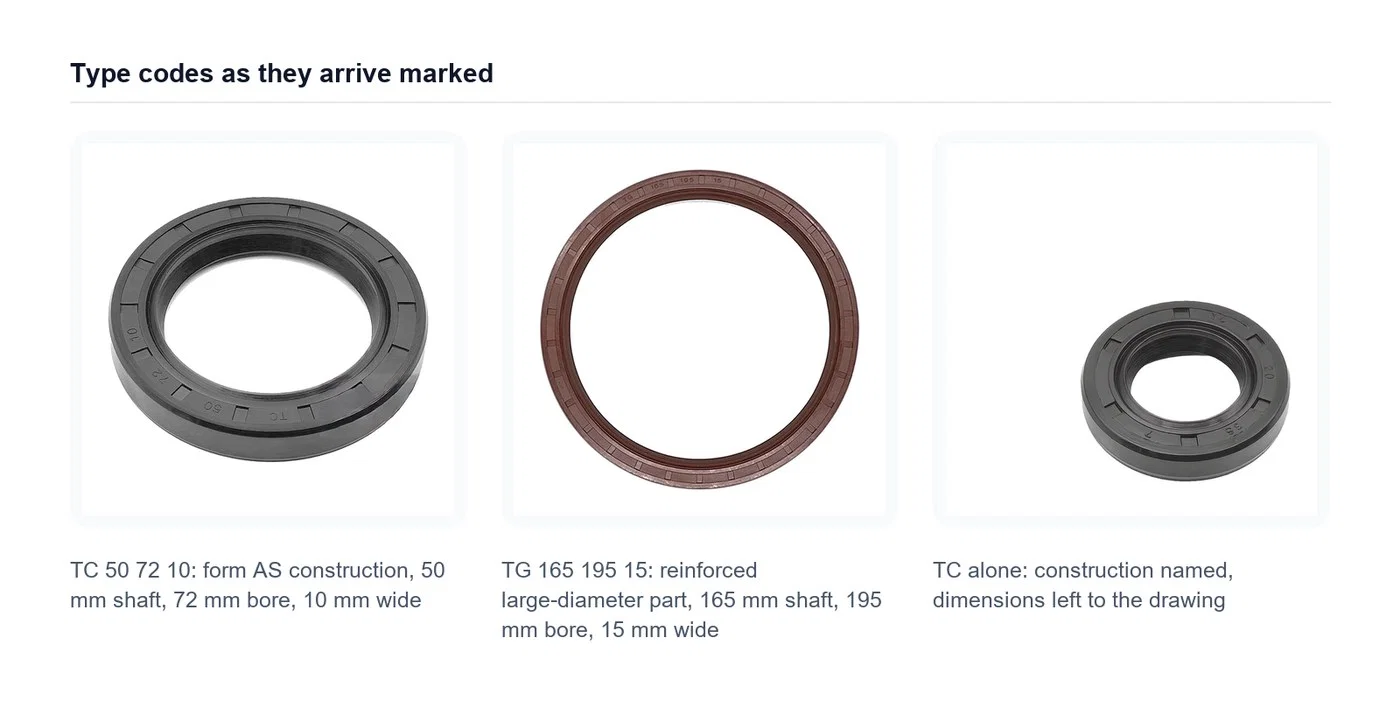
Take a marking straight off the shelf: TC 50 72 10. That reads as a 50 mm shaft, a 72 mm bore and a 10 mm overall width in the TC construction, which is form AS with its dust lip. One large cassette-style part marked TG 165 195 15 is a 165 mm shaft in a 195 mm bore, 15 mm wide. Digits carry the size. Letters carry the construction.
What the designation does not commit
Four things ride outside the letters, and each becomes a real error when assumed instead of confirmed.
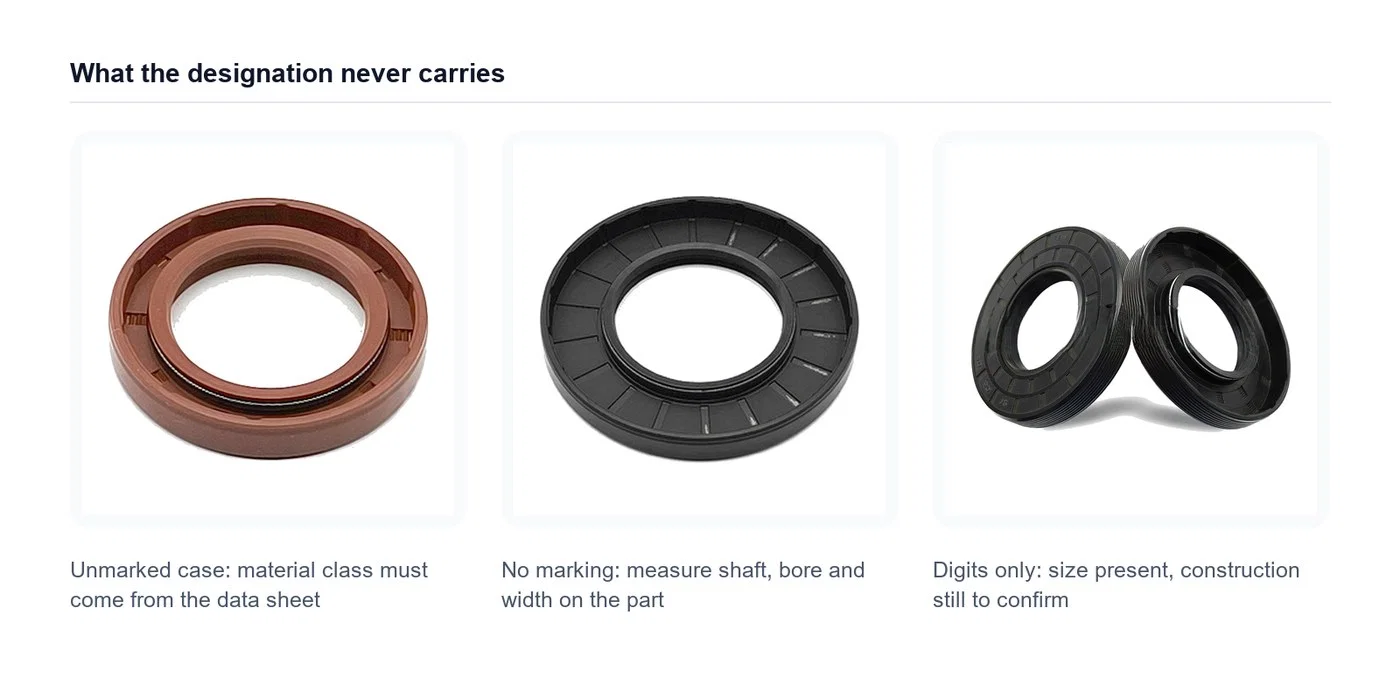
Material. Form letters say nothing about the elastomer. An SC and an SA can both carry NBR at -30 to +100 °C at the lip, or FKM to +250 °C. Confirm material per batch through the supplier's material test report.
Width. ISO 6194-1 clause 10 builds the size identification code from two nominal dimensions only: shaft diameter and housing bore. Marking 070090 therefore describes a 70 mm shaft in a 90 mm bore and says nothing about width. Table 1 of the same standard permits the nominal width to grow for more complex seal configurations. Clause 9.1 sets the width tolerance at ±0.3 mm for parts up to 10 mm wide, with wider bands above that. Letters add nothing here. Measure the seat, then order against the measurement.
Pressure. No letter is a pressure rating. ISO 6194-1 clause 6.1 places the standard single-lip seal at 0 to 30 kPa (0.3 bar) above atmospheric. S variants carry a dust lip that excludes contamination and holds back no fluid. Where a chamber sees real head pressure, the seal type changes, not the letter.
Fit. Letters imply how a case behaves in the bore, but the numbers live on the drawing: bore tolerance, seal OD tolerance band, lead-in chamfer. ISO 6194-1 fixes the housing bore at H8 and the shaft at h11 through clauses 8 and 7. Ask for values against the actual housing instead of trusting the form.
Reading the marking at goods-in
Checking a received batch takes minutes.
- Read the type code against a key you trust, then ask the supplier to state the construction in words: case type, lip count, spring. Words cannot drift between catalogues the way letters can.
- Measure all three dimensions on the actual parts. Compare width against the drawing seat rather than the nominal size string, because width is the dimension codes leave out.
- Verify the S suffix physically. Look for a dust lip on the air side. Any TC-marked part without one is mislabeled or mismade, and either fault needs a call before assembly.
- Check the case where the seal meets the bore: rubber or metal. That settles faster than any cross-reference table whether the outer-periphery letter survived translation.
- Request a dimensional report and a material test report with the first shipment of any new part number, and agree on the batch marking rule that ties a box to a production lot.
Questions buyers ask us
What does TC mean on an oil seal?
In the common trade key, T names a main sealing lip plus a dust lip, and C names a rubber-covered outer periphery. DIN 3760 calls the same construction form AS. Both readings include a garter spring. What the code does not say: elastomer, pressure capability, tolerance.
Is DIN 3760 form A the same seal as SC?
Yes. Form A is a single main lip with a garter spring and an elastomer-covered case, and SC is how the trade key names that construction. Confirm it against the supplier's own cross reference, because a second letter means a case type only inside one scheme.
Can I order by the letter code alone?
No. Codes identify construction, not size or material. State the measured dimensions and the material class next to the code, then add the fluid, its temperature plus the shaft speed. Ask the supplier to confirm the construction in words with a dimensional report.
Does the S suffix change the dimensions?
It can change the width. That second lip needs room, which is why ISO 6194-1's Table 1 footnote permits a wider seal for more complex configurations. A 65 mm by 90 mm seat specified around a 10 mm nominal width may be filled by a 12 mm part once the second lip is added. Verify the housing depth before assembly.
Why do two catalogues give different letters for the same seal?
Because the letter systems are catalogue conventions layered over the same geometry, and some houses move the metal-cased forms between DIN 3760 and DIN 3761. Treat letters as a starting point. Dimensions decide first. Construction described in words decides second. Material data settles the rest.
What to confirm before you order
Designations are filters, not specifications. Put the three measured dimensions and the case construction in words beside it in the enquiry. Add the material class and the fluid it will run in, plus the continuous operating temperature and the shaft speed. Ask for a dimensional report and a material test report on the first shipment, and for the batch marking rule that ties a delivered box to a production lot. With those in place, the letters on the box become what they were meant to be: a short way to say something the drawing already states precisely.
- Referenced: DIN 3760 (forms A, AS, B, BS, C, CS); ISO 6194-1 clause 5.2 (lip layout by agreement), clause 6.1 (0 to 30 kPa), clause 9.1 (width tolerances), clause 10 (size identification code).
Need help specifying a seal?
Use these checks to prepare your enquiry. Final suitability depends on the specific design and operating conditions.
Check dimensions and design
Provide the shaft diameter, housing bore and seal width in mm. Include the part marking, lip profile or a dimensioned drawing if available.
Describe operating conditions
Share the fluid or medium, operating temperature, pressure and shaft speed. Confirm the material grade against the application.
Verify a replacement
Provide the original part number and photos. Similar dimensions alone do not confirm interchangeability; compare the design and material.