NBR vs FKM Oil Seal: Where the 100 °C Line Decides
The NBR vs FKM oil seal choice turns on two numbers: both start at -30 °C, NBR stops at +100 °C, FKM at +250 °C. ISO 6194-4 clause 4.2 sets the rest.
NBR vs FKM Oil Seal: Where the 100 °C Line Decides
The NBR vs FKM oil seal choice turns on two numbers: both start at -30 °C, NBR stops at +100 °C, FKM at +250 °C. ISO 6194-4 clause 4.2 sets the rest.
Short answer
An NBR vs FKM oil seal decision comes down to two temperature figures and the fluid the seal will sit in. Nitrile covers -30 °C to +100 °C. Fluoroelastomer covers -30 °C to +250 °C, and both start at the same cold floor. Above the 100 °C line the material is chosen for you. Below it, nitrile stays the default for mineral oil and grease duty. A fluoroelastomer part earns its place only when the medium attacks nitrile, or when the sump runs hot enough that the lip crosses the line. Three inputs settle the question: the continuous temperature at the lip; the fluid family; the compound named on the material test report. A ranking that calls one rubber better tells a buyer nothing at the goods-in door.
Two windows that share a floor
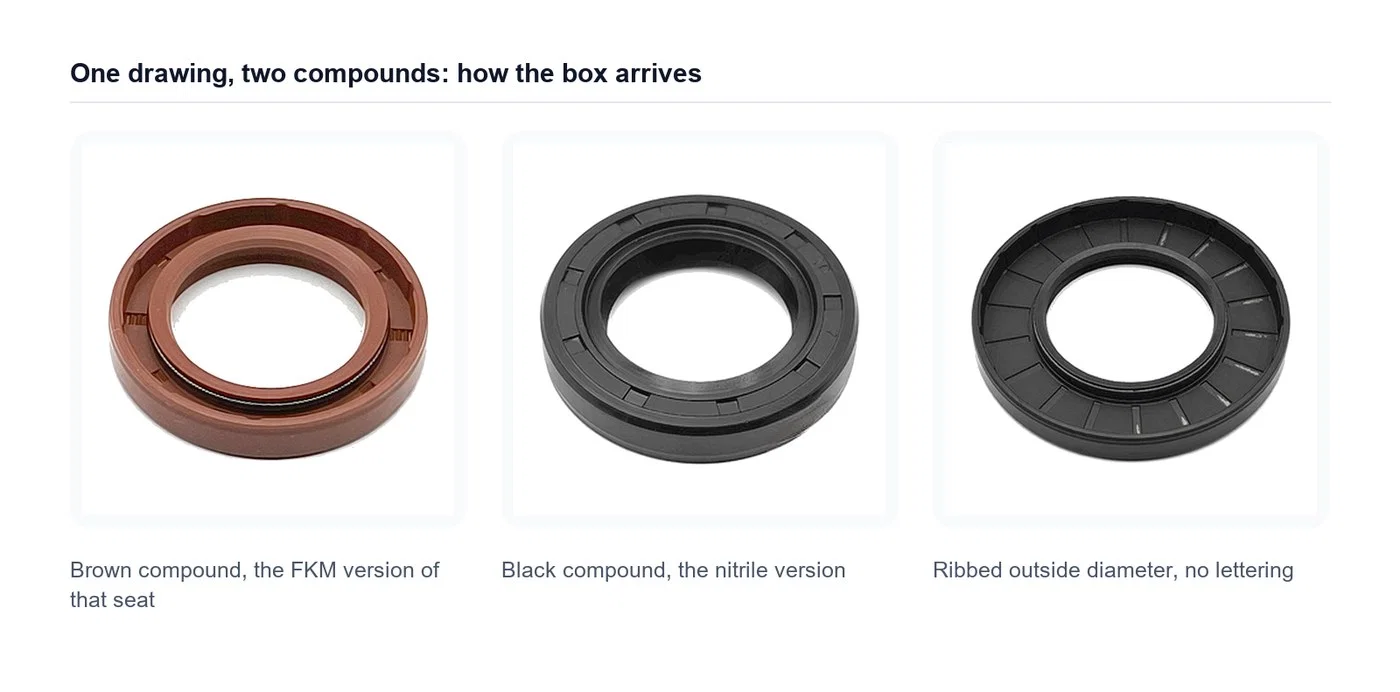
Temperature tables for these two materials usually sit side by side, as if the figures ranked them. Read the cold end first. Both stop at -30 °C, so a fluoroelastomer lip does not reach lower than a nitrile lip in the numbers a drawing office can actually work to. What FKM buys is 150 °C of headroom at the top. What NBR buys is a compound that stays flexible and bonds to a metal case without a long post-cure. It also tolerates a rougher assembly.
| Duty | NBR | FKM | What it decides |
|---|---|---|---|
| Temperature at the lip | -30 °C to +100 °C | -30 °C to +250 °C | the ceiling, never the target |
| Mineral oil, grease, diesel | works to +100 °C | works to +250 °C | nitrile holds most of this duty |
| Aromatic solvents, toluene, xylene | swells | resists | one fluid can retire nitrile |
| Ketones, acetone, MEK | attacked | attacked | change the polymer, not the grade |
| Liquid ammonia, amines | good | not recommended | the row that reverses the ranking |
| Glycol ether brake fluid | limited | not recommended | neither family is the answer |
| Steam above 120 °C | not recommended | not recommended | both leave; EPDM takes the duty |
| Storage life, ISO 6194-3 Table 1 | 7 years | 10 years | matters for slow-moving sizes |
One row in that table does more work than the rest. Liquid ammonia and amines attack standard fluoroelastomer, and two independent compatibility charts put FKM at the bottom of that column while nitrile sits comfortably. Refrigeration duty and gas sweetening belong to nitrile or to another polymer family entirely. So does any circuit carrying an amine-based corrosion inhibitor. Buying the top row because it sits at the top is how a seal fails in a fortnight.
The ceiling belongs to the lip
Bulk oil temperature is what a sump gauge shows. The lip works in a film that it shears at surface speed, and the contact band generates its own heat, so the rubber runs hotter than the oil around it. A pump that reads 90 °C on the gauge can put the contact band past 100 °C without anyone noticing, which is why a nitrile seal fails on a duty the maintenance log calls cool.
Duty cycle matters as much as the peak. Twenty minutes at high temperature once a shift, followed by a hot soak at shutdown, is a different question from a steady reading. Put both figures in the enquiry: the continuous lip temperature, then the peak with its duration.
Ask the compound supplier for one figure instead of a family range. The useful number is the highest continuous temperature the compound holds in your fluid, not the peak the data sheet advertises. Grades that reach +250 °C for an hour and harden at +180 °C in continuous service will not survive a gearbox sump, and no family name predicts that.
Where nitrile keeps the job
Ammonia and amine duty is the obvious case, and it is not the only one. FKM's rebound resilience and flex fatigue sit below nitrile's in two separate material references. Where a housing runs at the edge of its runout allowance the lip has to follow the shaft. Stiffer compounds follow less well. That gap matters more than 150 °C of headroom the duty never uses.
Compounding freedom runs the other way. Nitrile buys oil resistance with acrylonitrile content, so two NBR parts can behave very differently in the same oil. FKM grades differ in fluorine content and in how far down the cold end they reach. Either way the designation on the report is what you order, not the three letters of the family.
What the report declares
ISO 6194-4 clause 4.2 asks the supplier to declare, per batch: the material designation with its batch number; nominal density; nominal hardness; maximum compression set; maximum swell in a test liquid; and a low-temperature modulus where the duty needs one. Every item on that list is a declaration by the maker. None of it is a measurement the buyer witnesses.
| Declared value | Method named in the standard | What it leaves open |
|---|---|---|
| Nominal hardness | ISO 48 or ISO 7619-1 | hardness after the oil has been in it |
| Maximum compression set | ISO 815 | set at your temperature, after your fluid |
| Maximum swell | ISO 1817, in a liquid the supplier names | which liquid |
| Low-temperature modulus | ISO 1432 or ISO 2921 | behaviour once the shaft turns |
Read the third row twice. A swell limit without the liquid beside it is a number without a subject, and clause 4.2 does not force the supplier to name the oil on the face of the report. Ask for the liquid in writing before you compare two suppliers. A nitrile compound tested in a mild reference oil will beat an FKM compound tested in a harsh one and mean nothing by it.
The liquid in the beaker is the buyer's decision
ISO 1817 runs the immersion in reference oils. Three of them are standard: IRM 901 with an aniline point near 124 °C, IRM 902 near 93 °C, IRM 903 near 70 °C, all three fixed by ASTM D5964. Low aniline point means more aromatics, which means more swell in nitrile. So a report claiming 12 % swell proves nothing until it names the oil. Twelve per cent in IRM 901 and twelve per cent in IRM 903 describe two different seals.
The standard already knows this. It asks the laboratory to report the oil alongside the result, down to density and viscosity. Ask for the other half, then run the same oil on both compounds, because a cross-material comparison built on two different oils is a comparison of the oils.
Two labs, two answers
ISO 1817 Annex C carries the interlaboratory figures from a programme that covered NBR at 28 % acrylonitrile and FKM among other compounds. Over a 24 h immersion the repeatability for volume change is 3.61 % and the reproducibility 4.63 %. Hardness change comes with 1.10 IRHD and 4.18 IRHD against the same two measures.
Set those beside a purchase specification that says maximum swell 10 % and the arithmetic turns awkward. One lab reports 12 %, another reports 9 %, and no referee can separate them at that spread. The same holds for hardness: a 6 IRHD loss against a 5 IRHD limit sits inside the noise. ISO 3302-1 sets hardness tolerance at ±5 Shore A, which is about as wide as the interlaboratory scatter itself.
None of this makes the tests useless. It makes the acceptance limit a negotiated figure with a method attached, and it tells a buyer to keep one laboratory as the reference rather than split a batch across two.
Storage life separates them cleanly
One place where the standards put daylight between the materials is the shelf. ISO 6194-3 clause 4.5 gives storage life by elastomer in Table 1: ten years for FKM and seven apiece for NBR, ACM, AEM, HNBR. A store holding slow-moving sizes gains three years by stocking the fluoroelastomer version, provided the cartons sit per ISO 2230. It is the only gain in this comparison that arrives without a temperature argument.
A scale settles the family in ten minutes
Density differs enough to be useful at goods-in. Published compound ranges put nitrile at 1.00 to 1.20 g/cm³ and fluoroelastomer at 1.80 to 2.00 g/cm³. Weigh a part in air, then weigh it suspended in water. The two readings give the specific gravity without a laboratory.
Take a 90 mm shaft by 110 mm bore by 10 mm wide part. It holds roughly 25 cm³ of rubber. The nitrile version lands near 29 g, the FKM version near 46 g. A 17 g gap shows plainly on a 1 g scale, which is enough to catch a mislabeled carton before it reaches the press.
Limits apply. Steel at 7.8 g/cm³ in the case adds the same mass to both versions, so it dilutes the difference rather than removing it; compare two parts you already know on metal-cased forms. Filler loading also moves compound density. That is why the reference figure is the nominal density printed in the batch declaration, not a catalogue average.
Questions buyers ask us
Can I fit an FKM seal where an NBR seal sat?
Dimensionally yes, if the seal is the same size and the housing meets ISO 6194-1 clause 8.2 for the bore and clause 7.2 for the shaft. Check the fluid first. Fluoroelastomer in an ammonia circuit is a downgrade, and the bore will not tell you that.
Does FKM allow a higher shaft speed?
Speed limits come from the seal family and the surface it runs on, not from the polymer name. Convert with v = π d n / 60 000: a 60 mm shaft at 3 000 r/min gives 9.42 m/s. Ask the supplier for the surface speed the family is rated to. Compare that figure with your own.
Which temperature goes on the drawing?
The continuous temperature at the lip, followed by the peak and its duration. A sump reading is a starting point, not a specification. A single maximum with no duration leaves the supplier to guess.
Why did one seal swell and another not, in the same machine?
The oil changed, or the additive package did. Aniline point and aromatic content drive nitrile swell more than viscosity grade does, and a fluid change between services is the usual explanation.
Is a material test report enough to choose between the two?
It settles what was declared, not what your duty needs. Clause 4.2 covers what the batch declares: density, hardness, compression set, swell. Temperature at the lip and the duty cycle come from your side of the table. So does the fluid family.
What to put in the enquiry
Four items carry the decision. State the continuous lip temperature and the peak with its duration. Name the fluid, including the additive package if the oil is a gear or hydraulic grade. Ask for the compound designation with its batch number and the declared values under clause 4.2, with the test liquid named. Then ask which storage life applies under ISO 6194-3 Table 1 for the compound you are being offered. Ten years against seven changes how much a slow-moving size is worth holding.
- Standards referenced: ISO 6194-1 clause 8.2 (bore tolerance) and clause 7.2 (shaft tolerance); ISO 6194-3 clause 4.5 and Table 1 (storage life); ISO 6194-4 clause 4.2 (declared values); ISO 1817 with Annex C (immersion, repeatability); ISO 815 (compression set); ISO 48 and ISO 7619-1 (hardness); ISO 1432 and ISO 2921 (low-temperature modulus); ISO 3302-1 (hardness tolerance); ASTM D5964 (IRM reference oils).
Need help specifying a seal?
Use these checks to prepare your enquiry. Final suitability depends on the specific design and operating conditions.
Check dimensions and design
Provide the shaft diameter, housing bore and seal width in mm. Include the part marking, lip profile or a dimensioned drawing if available.
Describe operating conditions
Share the fluid or medium, operating temperature, pressure and shaft speed. Confirm the material grade against the application.
Verify a replacement
Provide the original part number and photos. Similar dimensions alone do not confirm interchangeability; compare the design and material.