NBR Oil Seal Material: What the ACN Content Decides Before You Buy
NBR oil seal material spans 18 % to 50 % acrylonitrile. ISO 6194-4 declares five values for a batch, and polymer composition is not one of them.
NBR Oil Seal Material: What the ACN Content Decides Before You Buy
NBR oil seal material spans 18 % to 50 % acrylonitrile. ISO 6194-4 declares five values for a batch, and polymer composition is not one of them.
Short answer
NBR oil seal material is a copolymer of butadiene and acrylonitrile. Its acrylonitrile share, shortened to ACN, runs from roughly 18 % to 50 % in commercial grades. That one number sets the trade: raising ACN improves resistance to oil and fuel while pushing the glass transition upward and the practical low-temperature limit with it. The word NBR on a drawing fixes none of this. ISO 1629 assigns the symbol from polymer chain chemistry alone, and ISO 6194-4 clause 4.2 asks a supplier to declare five measured values, none of which is composition. What separates two nitrile compounds is a number the seal trade rarely prints.
ISO 1629 gives you a family name, not a compound
ISO 1629:2025 is the fifth edition of the rubber nomenclature standard. It appeared in April 2025. It runs six pages. Its stated purpose is to standardize the abbreviated terms used by industry and government, based on the chemical composition of the polymer chain. Symbols fall into seven groups. Their letters run M, O, Q, R, T, U, Z. NBR sits in the R group of unsaturated carbon chains. Natural rubber and styrene butadiene rubber sit beside it. Emulsion polymerization and solution polymerization get the prefixes E- and S-.
Six pages cannot carry a specification. No hardness, no filler loading, no cure system, no acrylonitrile level appears in the symbol. Compounders publish NBR hardness from about 30 Shore A to 95 Shore A, so two seals cut from one polymer family can sit far apart in stiffness. Purchase orders stopping at the letters NBR name a chemistry, not a compound.
Two nitrile compounds exist as ISO references: 28 % and 34 %
ISO 6072:2011 fixes the reference elastomers used for comparing hydraulic fluids. Clause 4.2 defines NBR 1 as acrylonitrile-butadiene rubber with 28 % acrylonitrile content. Clause 4.3 defines NBR 2 at 34 %. Those are the only two nitrile compositions anywhere in the ISO system.
| Item | NBR 1, clause 4.2 | NBR 2, clause 4.3 |
|---|---|---|
| Acrylonitrile content | (28 ± 1) %, cold-polymerized | (34 ± 1) % |
| Mooney viscosity | (45 ± 5) ML (1 + 4) at 100 °C | (56 ± 5) ML (1 + 4) at 100 °C |
| Cure system | dicumyl peroxide, 3,0 parts | sulfur 0,5 with TBzTD 3,0 and CBS 2,0 |
| FEF carbon black N550 | 70,0 parts | 50,0 parts |
| Total by mass | 178,5 parts | 162,0 parts |
| Hardness, ISO 48 | 80 ± 3 IRHD | 70 ± 3 IRHD |
| Tensile strength, ISO 37 | ≥ 20 MPa | ≥ 15 MPa |
| Elongation at break, ISO 37 | ≥ 150 % | ≥ 300 % |
| Compression set, ISO 815-1 | ≤ 20 % after 22 h at 100 °C | ≤ 20 % after 22 h at 100 °C |
| Density, ISO 2781 | 1,23 ± 0,02 Mg/m³ | 1,18 ± 0,02 Mg/m³ |
Read down that table rather than across it. Between NBR 1 and NBR 2 the standard changes three variables at once. It changes the polymer; the filler loading; the cure. Peroxide cure with 70 parts of carbon black gives 80 IRHD and 150 % elongation. Sulfur cure with 50 parts gives 70 IRHD and 300 % elongation. Even inside the reference system the effect of acrylonitrile cannot be separated from the compound wrapped around it, which is the first point worth carrying into a supplier conversation.
The two reference nitriles nearly overlap in their own swelling window
Both reference compounds carry a control test for mass change after immersion, run by ISO 1817 for 22 h at (23 ± 2) °C in ISO liquid B, a mixture of 70 % 2,2,4-trimethylpentane and 30 % toluene by volume.
| Value | Test method | What it means for a buyer |
|---|---|---|
| NBR 1 mass change 27 %, recommended range 27 ± 5 | ISO 1817, 22 h at 23 ± 2 °C, ISO liquid B | The 28 % polymer swells more |
| NBR 2 mass change 23 %, recommended range 23 ± 5 | ISO 1817, identical conditions | The 34 % polymer swells less |
| NBR 1 window 22 % to 32 % | arithmetic on clause 4.2 Table 2 | Upper band |
| NBR 2 window 18 % to 28 % | arithmetic on clause 4.3 Table 4 | Lower band |
| Shared region 22 % to 28 % | arithmetic | Either compound fits a result inside it |
Six percentage points of acrylonitrile move the typical figure by four points. The recommended acceptance windows overlap by six. One mass-change result of 25 % satisfies both reference compounds. Swell measured this way grades a fluid against a rubber; it will not tell you which rubber you were sold.
ISO 6072 says as much about the material you actually buy. Clause 3.3 defines a commercial rubber as an elastomeric material for actual service "the composition of which is not given by the manufacturer", and adds that such materials are not advisable for quality control of media because they carry larger quality tolerances than test elastomers. Clause 4.1 asks for a single source for every ingredient of a reference batch plus a check on each batch produced. Neither safeguard reaches the seal in your carton.
What higher ACN buys, and what it costs
Every compounding guide states the same direction. Acrylonitrile carries a nitrile group with a strong dipole while hydrocarbon oils are non-polar, so raising the polar share of the chain reduces absorption. Raising ACN also raises the glass transition temperature. It stiffens the compound when cold. It tends to raise compression set.
| ACN band | Oil and fuel resistance | Practical low-temperature limit |
|---|---|---|
| 18 % to 20 % | Fair | about −50 °C |
| 28 % to 33 % | Good | about −40 °C |
| 36 % to 41 % | Very good | about −25 °C |
| 45 % to 50 % | Excellent | about −15 °C |
Figures in the last column disagree between sources, and the disagreement matters whenever a machine stands outside overnight. One sheeting supplier puts TR10 at −35 °C for a 28 % to 33 % band, −25 °C for 33 % to 36 % and −10 °C for 38 % to 45 %. Another technical source places 33 % to 34 % grades between −35 °C and −40 °C, with 39 % to 40 % grades between −25 °C and −30 °C. Those two accounts differ by 15 °C at one nominal grade. Rotary seal catalogues widen the spread further: one states an average ACN around 30 % for its standard nitrile, another states 34 %, and temperature limits appear variously as −30 °C to +100 °C and as −40 °C to +100 °C, with special grades reaching −50 °C.
Published grade numbers are screening data, not a rating for your shaft.
The low-temperature test that actually separates grades
ISO 2921:2019 measures temperature retraction, written as the TR test. Each strip is 2 mm ± 0,2 mm thick. It stretches at laboratory temperature; locks; cools to between −70 °C and −73 °C. That hold lasts 10 min ± 2 min under a slight tension of 10 kPa to 20 kPa. The lock releases, the bath warms at 1 °C per minute, and retraction is read at intervals no longer than 2 min until it passes 71 %. Four readings come off the curve: TR10; TR30; TR50; TR70. Each is a median of three.
Elongation is not a free choice. The standard offers 50 % as the default, 250 % where crystallization and low temperature are studied together, and 350 % where elongation at break exceeds 600 %. Its own note warns that results at different elongations need not agree. The heat transfer medium changes the floor too, since ethanol covers about −73 °C while methylcyclohexane cooled by liquid nitrogen reaches about −120 °C.
| Parameter | Repeatability r | Day repeatability rD | Reproducibility R |
|---|---|---|---|
| TR10 | 0,45 °C | 0,60 °C | 1,48 °C |
| TR30 | 0,49 °C | 0,64 °C | 1,88 °C |
| TR70 | 1,51 °C | 2,00 °C | 4,57 °C |
Those figures come from a 2017 interlaboratory comparison of ten laboratories and four materials, reproduced in Annex B. Reproducibility on TR70 runs three times wider than on TR10. Cold-start requirements written against TR10 hold up between two laboratories. Ones written against TR70 may not. GB/T 7758-2020 adopts ISO 2921:2019 identically, so a test report citing the Chinese number describes the same procedure.
What ISO 6194 asks you to declare, and what it leaves out
ISO 6194-4 clause 4.2 lists what a batch arrives with. Material designation and batch number come first. Then come nominal density by ISO 2781; nominal hardness by ISO 48 or ISO 7619-1; maximum compression set by ISO 815; maximum mass change in the test liquid by ISO 1817. Declared low-temperature service adds ISO 1432 or ISO 2921.
| Declared item | Method | What it does not tell you |
|---|---|---|
| Material designation | supplier's own name or code | Anything about composition |
| Batch number | traceability record | Which polymer went into it |
| Nominal density | ISO 2781 | Filler and polymer both move this figure |
| Nominal hardness | ISO 48 / ISO 7619-1 | Hardness follows the compound, not the polymer |
| Maximum compression set | ISO 815 | Cure system dominates the result |
| Maximum mass change | ISO 1817 | Which liquid, which temperature, which duration |
| Low-temperature figure | ISO 1432 or ISO 2921 | Appears only if the duty is declared cold |
Five numbers plus a name plus a batch code. None of them is acrylonitrile content. Two batches can satisfy every declared value in the series while sitting at opposite ends of the trade.
Reading a material code on a data sheet
Seal catalogues write compounds in a fixed pattern: hardness in Shore A, then the ISO 1629 symbol, then a three-digit number. The middle block is the family name discussed above. The trailing number belongs to whoever compounded the rubber, and it is the only part of the string identifying an actual formulation.
Record all three blocks. Watch the code between shipments. If it changes while size and drawing stay put, the compound changed. Any swell figure quoted against the earlier code no longer applies to the later one.
Telling a compound problem from a fitting problem
Three patterns separate the causes once a seal comes back. Leakage that appears only in the first minutes after a cold start, then stops as the sump warms, points at a lip too stiff to follow the shaft; the declared TR10 for that batch is the first thing to check. Leakage present from the first rotation at any temperature points at geometry or fitting instead, which ISO 6194-3 clause 7 and ISO 6194-5 clause 4.3 already cover. A lip that has hardened and crazed after a long hot run is an ageing signature, and the declared compression set from ISO 815 is the value that tracks it.
None of those three is settled by hardness alone. Keep the compound code with the complaint.
Questions buyers ask about NBR
Does 70 Shore A pin down the compound?
No. Filler loading and cure set hardness far more than the polymer does, and published NBR compounds run from about 30 Shore A to 95 Shore A. Two seals at 70 Shore A can differ by 20 percentage points of acrylonitrile.
Is an ISO 1817 swell figure enough to compare two offers?
Only when the liquid, the temperature and the duration match. ISO 6072 fixes ISO liquid B at 70 % 2,2,4-trimethylpentane and 30 % toluene for 22 h at 23 ± 2 °C. Figures quoted against mineral oil at 100 °C describe a different test.
What should I ask for when a machine starts cold?
Ask for ISO 2921 TR10, then state the elongation and the heat transfer medium next to it. TR10 reproduces to 1,48 °C across laboratories while TR70 reproduces to 4,57 °C.
Does higher acrylonitrile always last longer?
No. Higher ACN resists oil better and stiffens earlier in the cold. Seals compounded at 45 % can seal badly at start-up in a cold climate while passing every immersion test.
Can I identify the grade from a finished seal?
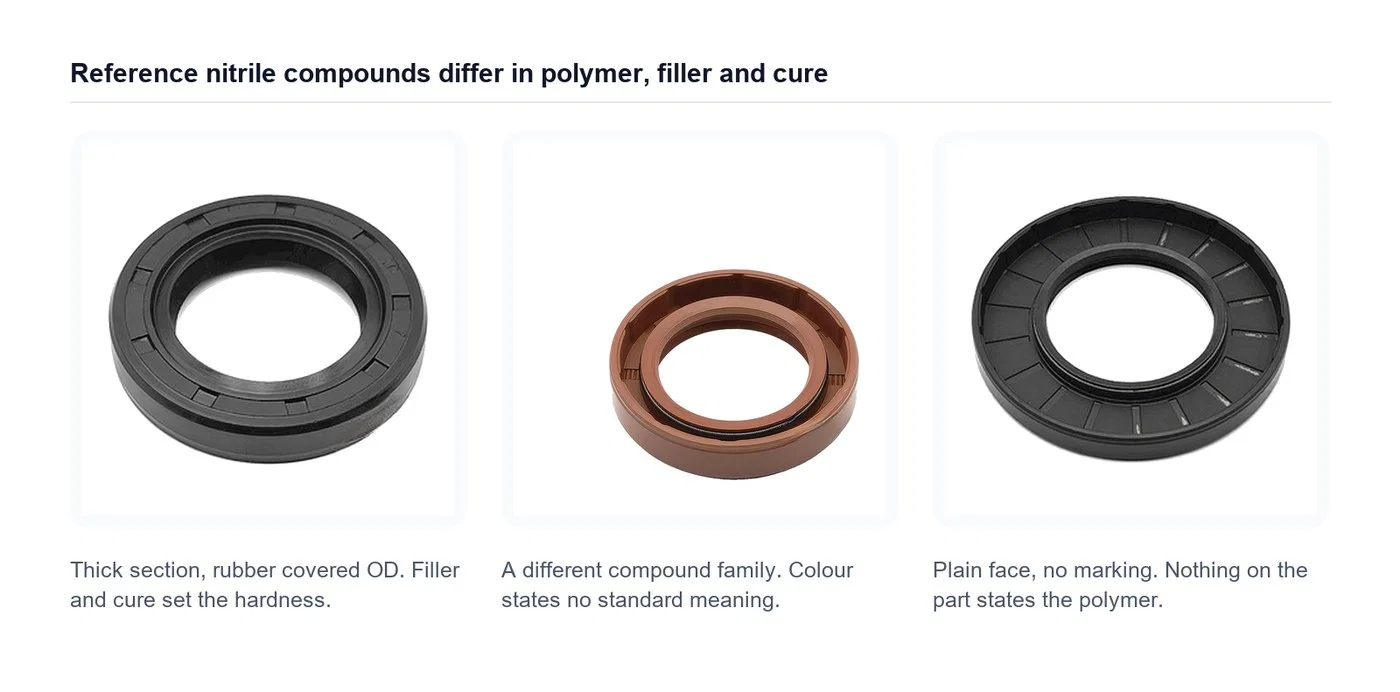
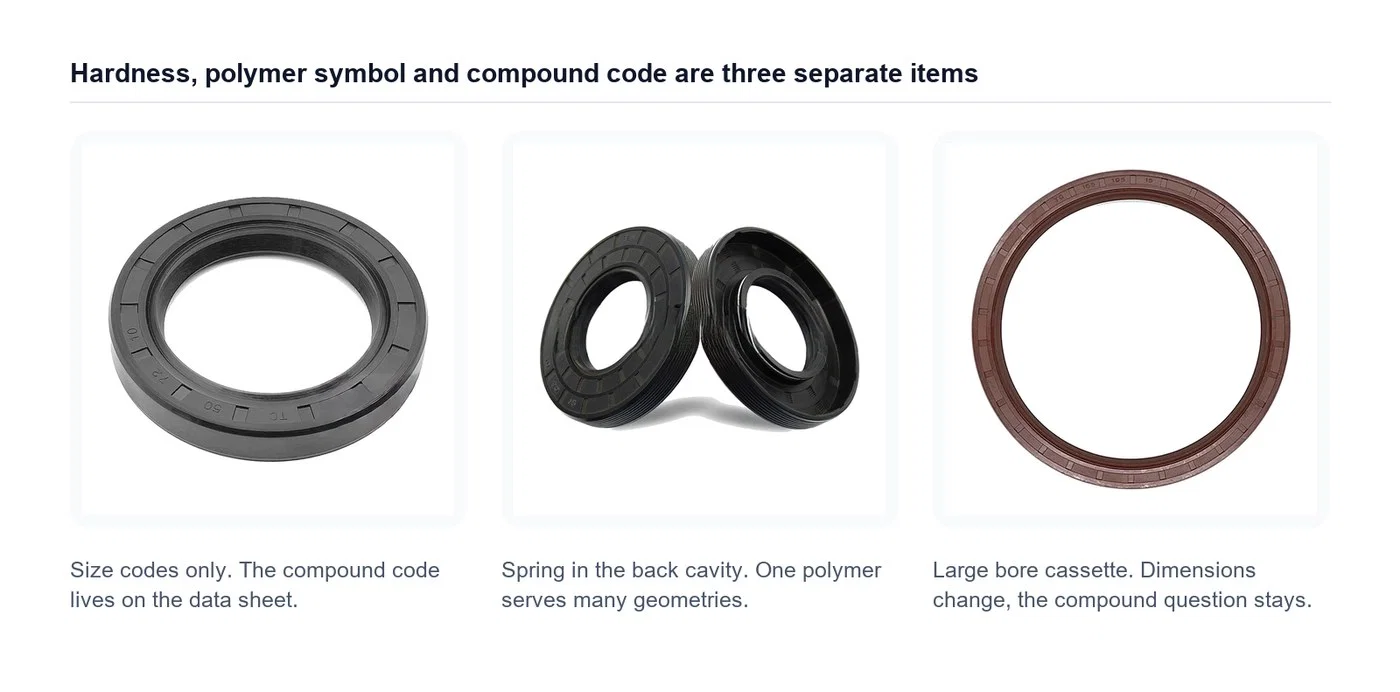
Not by looking. Colour carries no standard meaning, and the moulded size code reports dimensions only. The compound code plus the batch number on the test report are the route back.
Writing the requirement into the drawing and the order
Put the operating window on the enquiry first: medium and grade; continuous temperature; minimum start-up temperature; shaft speed; pressure above atmosphere. Add the compound code from the supplier you intend to hold. Ask that the test report carry that code; the batch number; the ISO 1817 conditions including liquid and temperature; an ISO 2921 TR10 with elongation stated. Where the seal sees sub-zero starts, make the low-temperature figure a declared value rather than a footnote.
Traceability then has something to attach to. Any batch that drifts can be checked against the declared values of clause 4.2. The compound code then shows whether a replacement is the same rubber or merely the same size.
Test methods referenced: ISO 1629:2025; ISO 6072:2011 clause 3.3, clause 4.1, clause 4.2, clause 4.3; ISO 6194-3 clause 7; ISO 6194-4 clause 4.2; ISO 6194-5 clause 4.3; ISO 2921:2019; ISO 1432; ISO 1817; ISO 2781; ISO 48; ISO 7619-1; ISO 815-1; ISO 37; ISO 2393; ISO 23529; GB/T 7758-2020.
Need help specifying a seal?
Use these checks to prepare your enquiry. Final suitability depends on the specific design and operating conditions.
Check dimensions and design
Provide the shaft diameter, housing bore and seal width in mm. Include the part marking, lip profile or a dimensioned drawing if available.
Describe operating conditions
Share the fluid or medium, operating temperature, pressure and shaft speed. Confirm the material grade against the application.
Verify a replacement
Provide the original part number and photos. Similar dimensions alone do not confirm interchangeability; compare the design and material.