NBR Cure System: What Peroxide and Sulfur Do to an Oil Seal
An NBR cure system decides how a nitrile lip ages. ISO 6194-4 clause 4.2 never asks for it, and clause 7 never measures tear strength.
NBR Cure System: What Peroxide and Sulfur Do to an Oil Seal
An NBR cure system decides how a nitrile lip ages. ISO 6194-4 clause 4.2 never asks for it, and clause 7 never measures tear strength.
Short answer
An NBR cure system is the crosslink chemistry that turns a nitrile compound from soft dough into elastic rubber. Sulfur systems tie polymer chains together with bridges carrying one, two or more sulfur atoms. Peroxide systems take hydrogen off the backbone instead and leave a direct carbon to carbon bond. That choice governs how the lip ages in service. Carbon to carbon links hold up under heat. Sulfur bridges let the network rearrange itself while it is compressed at temperature, and rearrangement is what a compression set figure measures. Buyers seldom get to select it directly. ISO 6194-4 clause 4.2 asks the seal manufacturer to state the material designation with its batch number. Nominal density comes next; then nominal hardness; then a maximum compression set value. Maximum mass change after immersion in the test fluid completes the list. Cure system is absent from that list. It reaches a purchase order only when the buyer writes it in. Writing "peroxide cured" on its own buys nothing that can be checked. Naming the test with temperature, duration and limit does.
What the crosslink actually is
Sulfur vulcanization builds bridges of sulfur atoms between chains, and the number of atoms in the bridge is set by the ratio of sulfur to accelerator. Peroxide curing works differently. Heat splits an organic peroxide into radicals. Those radicals strip hydrogen from the polymer backbone. Two stripped chains then join carbon to carbon.
Sources that tabulate bond energies agree on the ordering and disagree on the values. Figures for carbon to carbon sit between 345 and 348 kJ/mol. Carbon to sulfur lands somewhere from 260 to 285. Sulfur to sulfur is listed anywhere from 215 to 268. Only the ranking is stable. Heat attacks the lowest of the three first.
Peroxide cure runs hotter as well. Published cure windows put peroxide systems at 160 °C to 180 °C against 140 °C to 160 °C for accelerated sulfur.
"Sulfur cured" covers three different networks
One phrase on a data sheet hides three regimes. They do not behave alike.
| System | Sulfur, parts | Accelerator, parts | Dominant crosslink | What it buys | What it costs |
|---|---|---|---|---|---|
| Conventional | 2.0 to 3.5 | 1.0 to 0.4 | Polysulfidic | Tensile strength; tear strength; flex life | High compression set; poor heat ageing |
| Semi-efficient | 1.0 to 1.7 | 2.5 to 1.0 | Mixed poly, di and mono | A middle position on every axis | A middle position on every axis |
| Efficient | 0.3 to 0.8 | 6.0 to 2.5 | Monosulfidic | Heat ageing; low compression set | Tensile strength; tear strength |
A buyer reading "sulfur cured" has not yet learned which row applies. An efficient sulfur system approaches peroxide behaviour on heat and set while staying a sulfur system. That is why the two words alone carry so little information.
The reference nitriles in ISO 6072 sit at opposite corners
ISO 6072:2011 exists so that hydraulic fluids can be graded against a fixed baseline rather than against whichever compound a laboratory happens to hold. Clause 4.2 sets out NBR 1 with 3,0 parts dicumyl peroxide. Clause 4.3 sets out NBR 2 with 0,5 parts sulfur against 3,0 parts TBzTD and 2,0 parts CBS.
Read that second recipe against the table above. Five parts of accelerator against half a part of sulfur puts NBR 2 in the efficient corner, not in the conventional one. The standard's sulfur reference is therefore not the general purpose cure most nitrile parts receive.
The two differ in elongation as published: 150 % for the peroxide compound and 300 % for the sulfur one. Hardness moves with it, 80 IRHD against 70 IRHD, so the comparison is not clean. Neither is the filler loading, 70 parts against 50.
What ISO 6194-4 makes the supplier declare
Clause 4.2 of ISO 6194-4 is short and worth quoting in an enquiry, because it fixes what a batch has to arrive with.
| Declared item | Where it comes from | What it does and does not tell you |
|---|---|---|
| Material designation and batch number | Clause 4.2 | Establishes traceability to one production run |
| Nominal density | ISO 2781 | Catches a wrong compound; says nothing about ageing |
| Nominal hardness | ISO 48 | Sets stiffness; moves with filler as much as with cure |
| Maximum compression set | ISO 815 | Sensitive to cure, meaningless without temperature and duration |
| Maximum mass change in test fluid | ISO 1817 | Sensitive to polymer and fluid; weakly sensitive to cure |
| Maximum modulus at the selected low temperature | ISO 812 or as agreed | Only required where a low temperature test is run |
Cure system appears nowhere in that table. Traceability runs to the batch number. A change of cure inside one material designation stays invisible in the paperwork.
Clause 7.1 adds the sampling rule. Every batch feeding the test seals is tested, and subsequent production batches are tested on a random sample basis. That sentence is the whole traceability arrangement. Random sampling is a statistical device rather than a statement about any individual part.
The six batch tests, and the two properties nobody reports
Clause 7 runs from density through low temperature stiffness. Here is what it covers.
| Clause | Property | Method | What it catches |
|---|---|---|---|
| 7.2 | Density | ISO 2781 | A substituted compound |
| 7.3 | Hardness | ISO 48 | Drift in stiffness, within 7 IRHD |
| 7.4 | Compression set | ISO 815, 22 h, temperature by Table 2 | Loss of elastic recovery at heat |
| 7.5 | Fluid immersion | ISO 1817 | Swell, extraction, hardening in the liquid |
| 7.6 | Dry-heat ageing in air | ISO 188 | Hardening and embrittlement from heat |
| 7.7 | Stiffness at low temperature | As specified | Cold start behaviour |
Compression set sits at clause 7.4 and heat ageing at clause 7.6. Those are the two properties peroxide cure improves. Tensile strength by ISO 37 and tear strength by ISO 34-1 appear nowhere in clause 7, and those are the two properties peroxide cure tends to give up. A compound can satisfy the whole clause without a tear strength ever being measured on it.
The compression set figure everybody quotes is not comparable
Clause 7.4 fixes the duration at 22 h and sends the temperature to Table 2, which sorts it by elastomer. Most data sheets follow a convention that puts nitrile at 100 °C for 22 h, against 125 °C for EPDM and 200 °C for fluorocarbon.
Then look at what gets published. Three sulfur cured nitrile compounds at 70 Shore A report 3 %, 10 % and 12 % at 22 h and 100 °C. One peroxide cured nitrile sheet from a different maker reports below 20 %, and it reports that at 22 h and 70 °C, on a 60 Shore A material.
Nothing in that pair can be laid side by side. Hardness differs by 10 points. Test temperature differs by 30 °C. Two of the sulfur sheets quote ASTM D395 rather than the ISO 815 that clause 7.4 calls up. Rule of thumb says peroxide gives lower compression set. At the conditions buyers actually quote, published nitrile data does not show it.
Heat ageing, and an edition that has moved
Clause 7.6 covers dry heat ageing in air by ISO 188. ISO 188 was republished in March 2023 as edition 6, and the 2011 edition it replaced is withdrawn. ISO 815-1 still sends the oven to ISO 188 method A or method B, and warns that the two methods can disagree. A report has to name the edition and the method, or its numbers cannot be placed against anything.
Heat gain from peroxide is usually stated as a band rather than a value. One European material guide puts it at 10 °C to 15 °C over a comparable sulfur compound. Published at 70 Shore A, one sulfur cured nitrile data sheet gives a static range of -40 °C to 100 °C. A peroxide cured nitrile sheet is published at -40 °C to 125 °C in air and 120 °C in oil.
The sources do not close. At the cold end the sources disagree as well. One inverts the band, placing peroxide cured nitrile at -20 °C to 130 °C and crediting sulfur with better low temperature flexibility. The direction is consistent. The numbers are not, and a purchase order should not pretend otherwise.
Post cure is where the sources split
Tempering, also called post cure, holds finished parts at temperature to drive off volatile decomposition products. Dicumyl peroxide leaves acetophenone behind, which is why freshly moulded peroxide parts can smell. One elastomer glossary describes tempering as normal practice for peroxide and bisphenol crosslinked parts, and adds that most of the property gain arrives in the first 2 h to 4 h.
A compounding note takes the opposite position for nitrile. It says peroxide cured NBR does not suit secondary vulcanisation, because nitrile does not tolerate heat ageing as well as the fluorocarbon and EPDM compounds that normally receive it. Both positions are in print. Ask which one a supplier follows, and ask for the cycle, instead of assuming either.
Tear strength, splines, and the bond to the metal case
Lower tensile and tear strength is the consistent cost of a peroxide network. Every comparative source says so. That cost lands at fitting time.
ISO 6194-3 clause 7.9 requires a fitting tool wherever the lip has to pass splines, keyways or holes. It rules out soft metals such as aluminium. Clause 7.10 caps any step in the running area at 0.2 mm. Less tear strength leaves less margin against both.
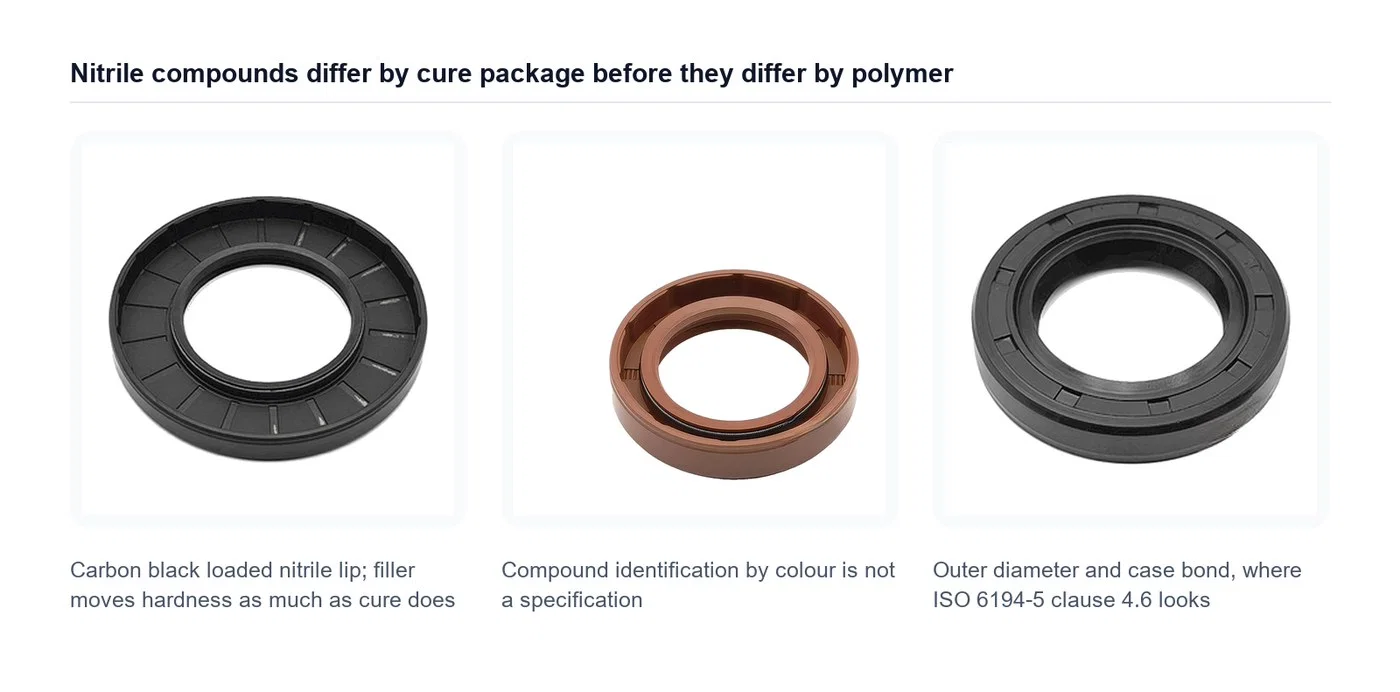
The bond between rubber and metal case is the second place cure shows up. One compounder's selection guide states that rubber to metal bonding needs an adhesive system validated for the specific cure system and the substrate, which means a bonding package proven on a sulfur compound is a fresh question on a peroxide one. ISO 6194-5 clause 4.6 lists incomplete bond among the outer diameter defects, so a visible bond gap is already a named defect rather than a matter of opinion.
What to put on the enquiry instead of "peroxide cured"
Name the polymer and the hardness with its method. Then name each property as a test with conditions attached.
- Hardness: ISO 48 with the nominal value and the tolerance in IRHD.
- Compression set: ISO 815-1 for 22 h; state the temperature; state the strain; state the limit.
- Heat ageing: ISO 188:2023 with the method, the hours and the temperature; give the limit on hardness change.
- Fluid: ISO 1817 with the liquid named and the temperature given.
- Optional, where the supply chain already works that way: an ASTM D2000 line callout. B14 is compression set at 22 h and 100 °C with a 25 % maximum. A14 is heat resistance at 70 h and 100 °C.
Then add the cure system as a written compound constraint, with the reason for it. Some suppliers publish it voluntarily; one European data sheet carries a field reading "type of cross-linking: sulfur". Ask for the field. Do not let it stand in for the numbers.
Reading a failure back to a cure decision
| What you see | Where it points | What to check first |
|---|---|---|
| Lip hard, cracked radially, dark and glazed | Heat ageing beyond the compound | Running temperature against the declared range; ask for ISO 188 data |
| Lip flattened, contact force gone, no cracks | Compression set at temperature | ISO 815 temperature and duration on the report |
| Lip torn or nicked right after fitting | Tear strength against the assembly path | ISO 6194-3 clause 7.9 tooling; steps over 0.2 mm |
| Rubber lifted from the metal case | Bonding system against the cure | ISO 6194-5 clause 4.6; which adhesive was validated |
| Swollen and soft, no heat damage | Fluid and polymer mismatch before cure | ISO 1817 liquid and temperature on the report |
Questions buyers ask
Can a test report prove which cure system was used?
No routine test in the ISO 6194 series returns crosslink type. Every one of those tests responds to the whole compound rather than to its crosslinks. Suppliers can declare the cure system, and several do. The numbers will not confirm it for you.
Does peroxide cure make a seal last longer?
It improves heat ageing and compression set in the published comparisons. It costs tensile and tear strength. Which of those governs a given application depends on running temperature and on the assembly path, so "longer" is not an answer a data sheet can give on its own.
Should I write peroxide cured on the drawing?
Write it if you have a reason tied to temperature, and write the reason next to it. Write the test conditions as well, because a cure name without conditions cannot be verified on delivery.
Why does the data sheet quote ASTM D395 when my enquiry says ISO 815?
Because many nitrile data sheets are built to an ASTM D2000 callout. The two are different test methods. Clause 7.4 asks for ISO 815, so a report built on ASTM D395 has to be reconciled before it is accepted against an ISO enquiry.
Does the cure system change the bond to the metal case?
It can. Bonding needs an adhesive system validated for the cure system and the substrate both. Any change of cure without a change of bonding package deserves a direct question.
What does "sulfur cured" mean on a data sheet?
Too little on its own. Three sulfur regimes give three different networks. The efficient one behaves closer to peroxide on heat and set.
Writing it back into your own specification
Put the polymer and hardness first. Attach conditions to every property you care about. Ask for the batch number with the declared values, and ask for the cure system in writing alongside them. Where a lip has to pass splines or a step, say so on the drawing, because that is where a lower tear strength becomes visible. Where running temperature sits above 100 °C, say that too. Ask for the ISO 188 figures at your temperature rather than at the supplier's.
- Test methods referenced: ISO 6194-1, ISO 6194-3, ISO 6194-4, ISO 6194-5, ISO 2781, ISO 48, ISO 815, ISO 815-1, ISO 1817, ISO 188, ISO 812, ISO 6072, ISO 37, ISO 34-1, ASTM D395, ASTM D573, ASTM D2000.
Need help specifying a seal?
Use these checks to prepare your enquiry. Final suitability depends on the specific design and operating conditions.
Check dimensions and design
Provide the shaft diameter, housing bore and seal width in mm. Include the part marking, lip profile or a dimensioned drawing if available.
Describe operating conditions
Share the fluid or medium, operating temperature, pressure and shaft speed. Confirm the material grade against the application.
Verify a replacement
Provide the original part number and photos. Similar dimensions alone do not confirm interchangeability; compare the design and material.