HNBR Oil Seal vs NBR: What a Test Report Cannot Show
An HNBR oil seal order turns on residual unsaturation. No clause in ISO 6194 asks for it: clause 4.2 names six declared values, and the polymer is not one.
HNBR Oil Seal vs NBR: What a Test Report Cannot Show
An HNBR oil seal order turns on residual unsaturation. No clause in ISO 6194 asks for it: clause 4.2 names six declared values, and the polymer is not one.
Short answer
An HNBR oil seal is a nitrile seal whose butadiene backbone has been partly hydrogenated, and the number that decides how it behaves is the residual unsaturation left after that step. Grades below roughly 1 % residual double bonds take a peroxide cure and carry the higher heat ceiling, near 150 °C in most published ranges. Grades sitting around 4 % to 7 % can take a sulfur cure that helps cold flexibility and dynamic duty while pulling the heat ceiling down. Both are sold as HNBR. Nothing in ISO 6194 asks a supplier to say which one you are buying.
Where the seal standards stop talking about polymer
ISO 6194-4 clause 4.2 is the only place in the series that tells a test house what to collect from the seal maker before a test starts. Six items appear there: material designation; batch number; nominal density; nominal hardness; maximum compression set; maximum volume change after immersion in the test fluid. Low-temperature work adds a seventh, the maximum modulus measured after test at the selected temperature.
Those are declared values, not measured ones. Manufacturers state them, and the clause asks nothing about how the polymer was identified. Clause 3.1.1 supports the same idea from the other side. It defines a batch as an identifiable and traceable consignment of rubber compound of definite composition produced in one operation, so the chain runs back to a compound the maker named.
Set a 70 Shore A NBR compound beside a 70 Shore A HNBR compound. Density can land in the same band; so can hardness; so can compression set and volume change. Both declarations come out identical.
What ISO 1629 means by HNBR
ISO 1629 builds its symbol system from the chemistry of the polymer chain, and edition 5, ISO 1629:2025, was published in April 2025 to replace ISO 1629:2013. The symbol table places HNBR in the R group, the rubbers with an unsaturated carbon chain. It glosses HNBR as hydrogenated NBR that still retains some unsaturation. A fully hydrogenated acrylonitrile-butadiene copolymer does not sit under that symbol. It carries its own code, NBM, over in the M group of saturated-chain rubbers.
That distinction has teeth. By the naming system, HNBR is the material that kept some double bonds. Commerce uses HNBR for nearly everything hydrogenated, so one word on a quotation covers compounds at 99 % hydrogenation and compounds at 90 % alike.
| Symbol | Group in ISO 1629 | What the code implies |
|---|---|---|
| HNBR | R, unsaturated carbon chain | Hydrogenated NBR retaining some unsaturation |
| NBM | M, saturated polymethylene chain | Fully hydrogenated acrylonitrile-butadiene copolymer |
| NBR | R, unsaturated carbon chain | Acrylonitrile-butadiene rubber |
The number that decides the compound
Residual double bonds, written RDB, is the share of butadiene double bonds still there after hydrogenation. Everything downstream follows from it.
Published figures put fully saturated grades under about 1 % RDB. Partly saturated grades sit near 4 % to 7 %. Patent literature describes 3 % to 4 % RDB as a working target when sulfur vulcanisation is wanted, and treats stopping the reaction at any chosen degree as routine. One producer's grade table pairs three hydrogenation levels with three iodine bands: 99 % with 5 to 9; 95 % with 12 to 20; 90 % with 24 to 32.
| Hydrogenation level | Iodine value, cg(I2)/g | Cure routes left open | Where it tends to go |
|---|---|---|---|
| 99 %, fully saturated | 5 to 9 | Peroxide or radiation | Hot service; static duty |
| 95 % | 12 to 20 | Peroxide; sulfur on some compounds | Mixed duty |
| 90 % | 24 to 32 | Peroxide or sulfur | Cold flexibility; dynamic duty |
Two caveats sit on that table. Those iodine values come from a single producer's published grades. Other producers cut the scale at different points, and iodine value is a proxy that patent literature calls imprecise next to infrared work while noting it fails when triphenylphosphine is present.
Three ways to measure it, and what each returns
| Method | What it measures | What a buyer can read from the result |
|---|---|---|
| ISO 14558:2016 | IR absorbance of a film cast from solution | Residual unsaturation of the raw polymer |
| ASTM D5670 | IR spectrophotometry of cast films | Residual unsaturation of the raw polymer |
| ASTM D5902 | Iodine value by the Wiijs procedure | Iodine value in cg(I2)/g; needs the base polymer value to become a percentage |
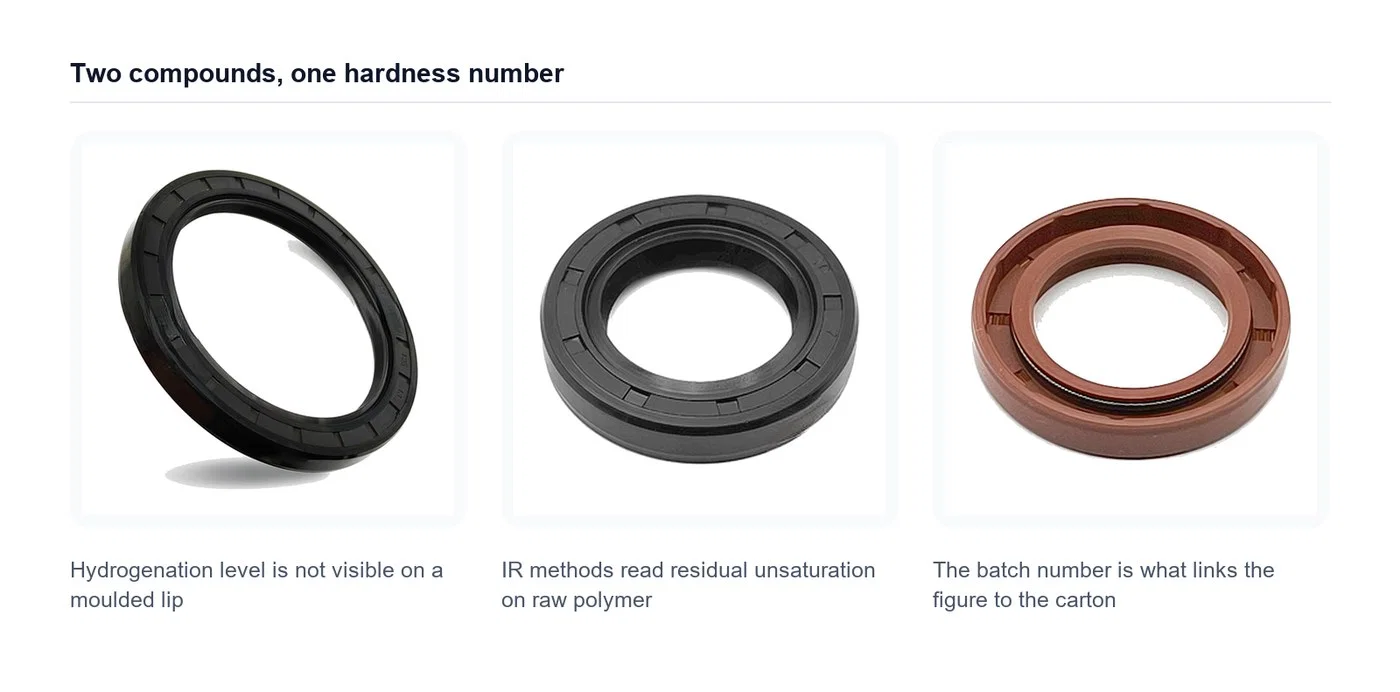
All three act on raw polymer. Its scope says so plainly: ASTM D5670 limits the method to HNBR in the raw state. A moulded lip carries carbon black; plasticiser; a cured network. That is not a cast film, so no laboratory can run these on a finished seal and defend the result. That figure has to come from the polymer or compound stage, and the batch number has to tie it to the cartons you receive.
A second limitation sits in ASTM D5902. Its scope states that iodine value can be turned into a percentage of residual unsaturation only when the iodine value of the base polymer before hydrogenation has been determined. A report showing 8 cg(I2)/g with no reference figure behind it cannot be converted.
Why the cure system follows from saturation
Section 4 of ASTM D5670 puts it in two sentences. Highly saturated grades give the best resistance to heat; to ozone; to chemicals. They can be cured effectively only with peroxides or high-energy radiation. Partly unsaturated grades can also take a sulfur system.
A sulfur-cured HNBR is therefore not a counterfeit. It is a compound out at the higher-RDB end of the scale. Sulfur curing buys low-temperature flexibility there, along with better dynamic behaviour. The cost lands on the hot side. Compound guidance there puts heat resistance and compression set at temperature behind peroxide curing.
Ask for the cure system, and ask for it next to the RDB figure. Either one alone leaves the picture half finished.
Heat: where the two materials separate
Catalogue ranges tell the story. NBR is normally quoted from -30 °C to +100 °C, with short excursions to 120 °C and special grades reaching -50 °C. HNBR is quoted from -30 °C or -40 °C to +150 °C, with special compounds at -55 °C and +165 °C. The gain is roughly 50 °C of continuous ceiling, and it sits on the hot side. The cold ends overlap.
ISO 6194-4 clause 5.3 explains why the hot number has to be written down. Test conditions are whatever purchaser and supplier agree: normal operating temperature; normal operating shaft speed; maximum envisaged operating temperature; maximum envisaged shaft speed. Leave the temperature open, and the compression set on your report was measured somewhere you did not choose.
Pressure is a separate matter. Clause 6.1 of ISO 6194-1 puts the whole family near 0 kPa to 30 kPa, and no polymer change lifts that ceiling.
What hydrogenation does not change
Three gains get attributed to hydrogenation. Hydrogenation delivers none of them.
Fluid lists stay where they were. HNBR keeps the oil and fuel resistance of NBR; it keeps the grease resistance too. The exclusions travel with it: ketones; esters; aldehydes; chlorinated hydrocarbons. One catalogue states the media resistance of HNBR is the same as that of NBR. ACN content drives fluid behaviour. Published grade tables place HNBR between 17 % and 49 % ACN. The trade is the same one NBR runs between oil resistance and cold flexibility.
Storage life stays where it was too. ISO 6194-3 Table 1 caps butadiene/acrylonitrile (NBR) at 7 years and hydrogenated NBR at 7 years, and it prints the hydrogenated entry with its own parenthesis, HNBR with some unsaturation. Fluorocarbon gets 10. That purchase buys wear resistance along with heat resistance. Shelf life is not part of it.
Cold flexibility does not improve by default. Low-ACN grades are the ones quoted down to -55 °C, and they trade away heat life to get there. A standard grade bought for 150 °C duty is unlikely to be the one that survives a -45 °C start.
Reading the material test report
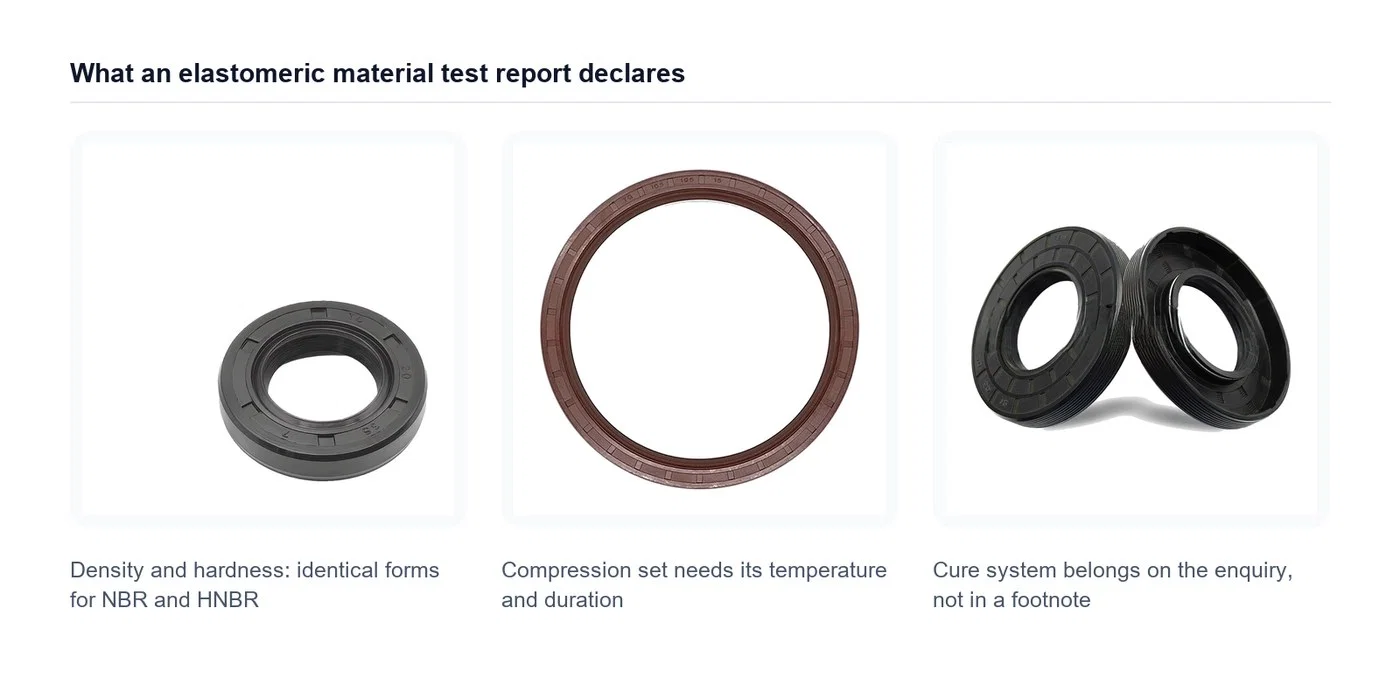
Annex C of ISO 6194-4 carries a typical example of an elastomeric material test report, and asking for that form is the simplest opening move. The clause 4.2 items travel with it: material designation; batch number; nominal density; nominal hardness; maximum compression set; maximum volume change.
Then push four lines further. Name the hardness method, ISO 48 or ISO 7619-1. Give the compression set its conditions. ISO 815-1 covers ambient or high temperatures; ISO 815-2 covers low ones. A percentage without a temperature and a duration cannot be compared with anything. Give the immersion figure its fluid; its temperature; its duration, since ISO 1817 admits a wide span of all three. Add polymer identification at compound stage, residual unsaturation to ISO 14558 or ASTM D5670, plus the cure system.
What to write into the enquiry and the drawing
- Polymer code to ISO 1629, with the ACN target range;
- Maximum residual unsaturation, and the method it was measured by;
- Cure system, peroxide for hot service, sulfur only where cold flexibility or dynamic duty dominates;
- Test temperature and duration for the compression set and the immersion figures;
- Batch number on every carton, tied to the declared values;
- A sampling level stated as an ISO 2859-1 AQL, which is a statistical risk level rather than a zero-defect statement;
- Shaft and bore geometry left where ISO 6194-1 puts it, shaft to h11, bore to H8, shaft surface Ra 0.2 µm to 0.5 µm, shaft hardness at least 30 HRC.
Seven lines, and each one can be checked against delivered parts.
Failure diagnosis: when HNBR was the wrong call
| Symptom | Where it points | What to check first |
|---|---|---|
| Lip hardened and cracked after a hot run | Compound ran past its ceiling | Cure system and RDB; continuous temperature against 150 °C |
| Cold-start weep on a grade bought for heat | ACN too high for the start | Low-temperature grade; brittleness data to ISO 812; ISO 815-2 conditions |
| Swollen lip with the polymer confirmed | Fluid outside the nitrile window | Fluid list, which hydrogenation does not extend |
| Weeping from the first start | Not a material problem | Shaft finish, runout, installation damage |
FAQ
Does HNBR replace NBR everywhere?
No. It buys abrasion resistance along with heat and ozone resistance, roughly 50 °C more continuous ceiling. It keeps the same fluid list and the same 7-year storage cap.
Can a supplier sulfur cure a fully saturated HNBR?
Not effectively. ASTM D5670 leaves peroxide or high-energy radiation as the routes for highly saturated grades, because sulfur needs double bonds to react with.
Can we test a finished seal for residual unsaturation?
No. Both infrared methods work on films cast from raw polymer. Ask for the figure at compound stage and tie it to the batch number.
Is the storage life different?
No. ISO 6194-3 Table 1 gives 7 years for NBR and 7 years for hydrogenated NBR, against 10 years for fluorocarbon.
What is the most useful single line on an enquiry?
Maximum residual unsaturation with the method named. Cure route follows from it. So do the heat ceiling and the cold behaviour.
Standards referenced in this article
ISO 48, ISO 812, ISO 815-1, ISO 815-2, ISO 1629, ISO 1817, ISO 188, ISO 2230, ISO 2781, ISO 2859-1, ISO 6194-1, ISO 6194-3, ISO 6194-4, ISO 7619-1, ISO 14558, ASTM D1418, ASTM D5670, ASTM D5902.
Need help specifying a seal?
Use these checks to prepare your enquiry. Final suitability depends on the specific design and operating conditions.
Check dimensions and design
Provide the shaft diameter, housing bore and seal width in mm. Include the part marking, lip profile or a dimensioned drawing if available.
Describe operating conditions
Share the fluid or medium, operating temperature, pressure and shaft speed. Confirm the material grade against the application.
Verify a replacement
Provide the original part number and photos. Similar dimensions alone do not confirm interchangeability; compare the design and material.